
Why Multi-Week Icefox Equipment Modular Pod Leasing Beats Investing in Permanent Cold Storage
Article Plans
Cold-storage demand does not always justify a permanent building. When the need lasts several weeks, a leased modular pod from Icefox Equipment can provide refrigerated or frozen capacity without forcing your company to commit to a construction project that may outlast the operational problem.
A 20-foot refrigerated trailer is listed at $1,495–$2,395, while a 20-foot refrigerated container is listed at $2,495–$2,995 under the supplied planning guide. Those ranges give you a defined temporary equipment cost before delivery, electrical work, and other project-specific charges are added.
Quick Answer: Multi-week modular pod leasing often beats permanent cold-storage investment when the need is temporary, uncertain, seasonal, or connected to a renovation. Icefox Equipment offers configurations from 7 × 12 feet to 8 × 40 feet, with emergency delivery sometimes available within 12 hours, while permanent construction requires site, capital, and timeline commitments not documented in the supplied sources.
Quick Facts
- A 12-foot refrigerated trailer is listed at $1,295–$2,195.
- A 20-foot refrigerated or freezer trailer is listed at $1,495–$2,395.
- A 20-foot refrigerated container is listed at $2,495–$2,995.
- A 40-foot refrigerated container is listed at $2,995–$3,995.
- A 20-foot trailer may accommodate approximately 6–8 standard pallets.
- Icefox Equipment advertises 24/7 support and emergency delivery in some cases within 12 hours.
Key Takeaways
- Leasing provides defined planning-level equipment pricing from $1,295 to $3,995, depending on the selected refrigeration configuration.
- A leased pod can be scaled from a 7 × 12-foot walk-in unit to an 8 × 40-foot configuration without permanently enlarging the facility.
- A 20-foot refrigerated container provides approximately 1,000–1,100 cubic feet, while a 40-foot container provides approximately 2,200–2,400 cubic feet.
- Permanent construction may be appropriate for predictable long-term demand, but the sources provide no supported break-even period for comparing a lease with ownership.
- Projects lasting more than 6, 12, or 24 months may qualify for preferred rental pricing, depending on the quotation.
Why Does Leasing Work Better for a Multi-Week Need?
Leasing works better when the cold-storage requirement has a clear ending or an uncertain future. A renovation, seasonal inventory increase, equipment replacement, special production run, or temporary overflow problem may require refrigeration for 1 or more billing periods, but it may not justify owning an additional permanent room after the project ends.
Icefox Equipment offers both short-term rentals and longer leasing arrangements for temporary, scalable cold storage. The company states that its refrigerated containers support both chilled and frozen applications, rapid placement, flexible leasing terms, and 24/7 maintenance assistance.
From a facilities perspective, leasing also preserves reversibility. A 20-foot pod can be removed when the renovation closes, while a permanent addition remains part of the property even if inventory volumes return to their earlier level.
How Much Does Modular Cold Storage Leasing Cost?
The sourced rental guide lists several planning-level options rather than a single pod price. Actual pricing depends on rental duration, location, freight, utilities, seasonal demand, availability, and the equipment configuration.
| Cold-storage option | Planning-level rental range | Sourced capacity or use |
|---|---|---|
| 12 ft refrigerated trailer | $1,295–$2,195 | Compact temporary refrigeration |
| 20 ft refrigerated trailer | $1,495–$2,395 | About 6–8 standard pallets |
| 20 ft freezer trailer | $1,495–$2,395 | Approximately 0°F to -10°F |
| 20 ft refrigerated container | $2,495–$2,995 | About 1,000–1,100 cu. ft. |
| 40 ft refrigerated container | $2,995–$3,995 | About 2,200–2,400 cu. ft. |
These figures should be treated as equipment-planning ranges rather than total installed prices. Freight, delivery, setup, licensed electrical work, temporary power, permits, monitoring, ramps, and site preparation may be separate line items on a 1-project quotation.
Why Is the Cost Easier to Control Than a Permanent Build?
A lease defines the refrigeration equipment being used and the term during which it is needed. A permanent build can involve design, permitting, site work, structural construction, insulation, refrigeration installation, electrical upgrades, inspections, financing, taxes, and continuing maintenance. [NEEDS DATA: sourced permanent construction cost and project duration]
The strongest financial advantage is therefore not a fabricated percentage or universal payback claim. It is the ability to avoid making a permanent capital decision for a temporary requirement while selecting equipment within the sourced $1,295–$3,995 planning ranges.
We would not recommend building a permanent room solely to solve a short inventory surge unless the company has documented long-term demand. The supplied sources provide no construction-cost figure or ownership break-even month, so that decision must be based on a project-specific capital analysis.
How Does Leasing Reduce the Risk of Buying the Wrong Size?
Leasing lets you match capacity to the actual inventory problem instead of predicting storage demand years in advance. Icefox Equipment lists freezer dimensions including 7 × 12, 7 × 20, 7 × 26, 8 × 20, and 8 × 40 feet.
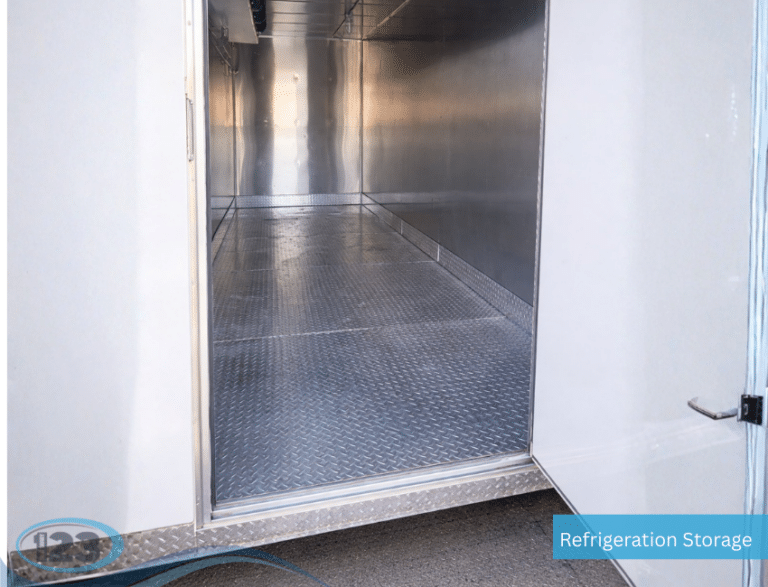
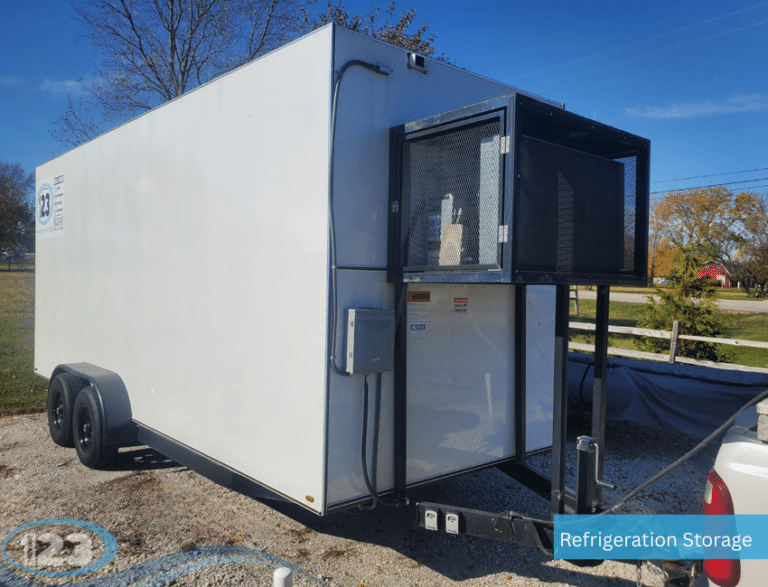
A 20-foot refrigerated trailer may hold approximately 6–8 standard pallets, depending on pallet dimensions. Facilities that require more open floor capacity may consider a 20-foot container with 1,000–1,100 cubic feet or a 40-foot container with 2,200–2,400 cubic feet.
This modular approach supports phased capacity. You can lease 1 unit for the first project stage and request additional equipment if inventory, construction sequencing, or production volume changes.
How Quickly Can a Modular Pod Become Operational?
Icefox Equipment states that emergency walk-in freezer rentals can sometimes be delivered within approximately 12 hours, depending on location and availability. The company also advertises 24-hour service for urgent refrigeration requirements.
Delivery does not guarantee immediate startup because the site must provide the correct electrical service and access. Standard 7 × 12-foot and 7 × 20-foot walk-ins require 30-amp, 208–230V, single-phase power, while a 20-foot refrigerated trailer may require 220V, single-phase service at 40–60 amps.
A reefer container may instead require 220–480V, 3-phase, 30-amp service. The electrician must use the delivered equipment nameplate rather than assuming that every Icefox Equipment pod shares 1 electrical specification.
How Does a Lease Support Renovations and Phased Construction?
A temporary pod can keep inventory onsite while contractors work inside the permanent cold room. This separates refrigerated goods from dust, demolition, floor replacement, utility work, and equipment installation during 1 or more construction phases.
Icefox Equipment describes temporary freezer leasing as a way to preserve cold-chain operations during freezer expansions, modernization, structural repairs, floor replacement, utility upgrades, and warehouse automation projects. A 20-foot freezer trailer is listed around $1,500–$2,400, while a 40-foot refrigerated container is listed around $3,000–$4,000 on the company’s current renovation resource.
The practical advantage is continuity. Your team can preserve current operations while the permanent system is repaired or replaced, rather than tying the construction schedule to the entire facility’s ability to store 1 day of inventory.
When Is Permanent Cold Storage the Better Choice?
Permanent cold storage may be the better option when demand is stable, long term, supported by predictable inventory growth, and tied to the property’s core operation.
A permanent system may also make sense when the facility has no suitable exterior placement area or when repeated temporary delivery costs would exceed the ownership case over a documented period. The supplied sources do not establish 1 universal month or year when ownership becomes cheaper.
Leasing should not be presented as the correct choice for every project. Icefox Equipment’s own product family supports temporary, semi-permanent, and permanent configurations, allowing the final decision to reflect the facility’s actual operating horizon.
What Site Conditions Are Needed for a Modular Pod?
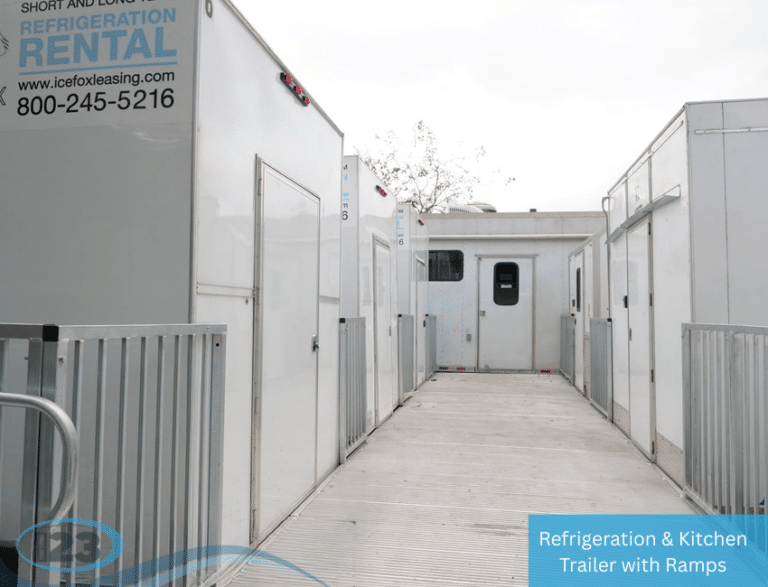
The site should generally provide a 12-foot minimum gate, 14-foot minimum overhead clearance, and approximately 60 feet of turning radius for delivery. Concrete, asphalt, or compacted gravel is preferred over mud, sand, or unstable soil.
The Icefox Equipment COOLBOX STRUCTURES™ system may be configured for temporary, semi-permanent, or permanent placement, but the site must still support the unit, power connection, service access, drainage, and any local permitting requirement.
A 40-foot container needs more placement and maneuvering space than a 12-foot trailer. Most customers should select the smallest configuration that safely holds the required inventory while preserving door access, airflow, aisle space, and technician clearance.
What Is the Multi-Week Leasing Process?
Icefox Equipment can use the following 6-step process to size and deploy temporary cold storage:
- Define the inventory. Record the number of pallets, product type, target temperature, and estimated 1-day peak volume.
- Choose the configuration. Compare a 12-foot trailer, 20-foot trailer, 20-foot container, or 40-foot container.
- Confirm power. Verify 30-amp, 40–60-amp, or 3-phase 30-amp service, depending on the delivered unit.
- Inspect the site. Confirm a 12-foot gate, 14-foot clearance, 60-foot turning radius, and stable ground.
- Review total costs. Include the sourced rental rate plus delivery, setup, electrical work, permits, monitoring, and 1 removal charge where applicable.
- Test before loading. Operate the empty unit until it reaches the required temperature before transferring the first 1 pallet.
What Common Leasing Mistakes Should You Avoid?
Choosing by Price Instead of Capacity
The lowest $1,295 starting range may not support the required pallet count or workflow. Compare inventory volume with the documented 6–8-pallet, 1,000–1,100-cubic-foot, or 2,200–2,400-cubic-foot capacities.
Ignoring Electrical Differences
A 30-amp, 208–230V walk-in pod is not electrically identical to a 40–60-amp, 220V trailer or a 30-amp, 3-phase reefer container. Confirm the delivered nameplate before the electrician installs the connection.
Comparing Rent With an Incomplete Construction Estimate
A valid comparison must include design, construction, refrigeration equipment, electrical upgrades, permits, maintenance, financing, and property-related costs.
Loading the Unit Before Testing It
Icefox Equipment walk-in units may operate from approximately -20°F to 35°F or higher, depending on the configuration. Confirm that the selected setting remains stable before moving regulated, perishable, or high-value products.
Forgetting End-of-Lease Costs
The equipment rate may exclude freight, installation, utilities, fuel, site work, and removal. Request 1 itemized quotation instead of comparing only the monthly rental figure.
Modular Pod Leasing Decision Checklist
- Confirm the expected project duration and whether it exceeds 6, 12, or 24 months.
- Count the inventory and determine whether you need space for 6–8 pallets or a larger cubic-foot capacity.
- Select a 12-foot, 20-foot, or 40-foot configuration based on usable storage rather than exterior size alone.
- Confirm the required temperature between approximately -20°F and 35°F or higher.
- Verify 208–230V, 220V, or 220–480V power based on the exact unit.
- Confirm a 12-foot gate, 14-foot clearance, and 60-foot turning radius.
- Request separate pricing for delivery, installation, electrical work, monitoring, permits, and removal.
- Obtain permanent-build figures before claiming a specific 1-month or 1-year break-even point.
- Call Icefox Equipment at 800-245-5216 for 24/7 leasing support.
Request a Quote
Request a quote today for industry-leading refrigeration, modular facilities, and mobile equipment solutions. Ice Fox Equipment provides rapid deployment, flexible rental and leasing options, and dependable support for construction, healthcare, food service, emergency response, and industrial operations. Contact our team now for a customized, no-obligation quote.
Frequently Asked Questions
Icefox Equipment planning-level refrigeration rates range from $1,295–$2,195 for a 12-foot trailer to $2,995–$3,995 for a 40-foot refrigerated container. Final pricing depends on duration, delivery, location, utilities, availability, installation, and the selected refrigeration or freezer configuration.
No. Icefox Equipment leasing is often more practical for a multi-week, seasonal, renovation, or uncertain requirement, but the sources provide no permanent construction cost or universal break-even period. A valid comparison requires the installed build price, financing, energy use, maintenance, taxes, depreciation, and expected years of operation.
An Icefox Equipment 20-foot refrigerated trailer may accommodate approximately 6–8 standard pallets. A 20-foot refrigerated container provides approximately 1,000–1,100 cubic feet, while a 40-foot refrigerated container provides approximately 2,200–2,400 cubic feet, subject to aisle and product-clearance requirements.