
How to Transfer Frozen Food to a Rental Unit | IcefoxEquipment
Article Plans
The safest way to transfer frozen food into temporary cold storage is to have the rental freezer powered, operating, and verified before the 1st case leaves your permanent freezer. IcefoxEquipment supports temporary refrigeration projects with freezer trailers, refrigerated trailers, and containers, including a documented 20-ft freezer trailer operating from 0°F to -10°F.
A frozen-food transfer should be planned as an operating procedure, not a moving job. Confirm power, temperature, loading order, airflow, and monitoring before opening either freezer door. Visit IcefoxEquipment or call 800-245-5216 when planning the temporary refrigeration portion of the project.
Quick Answer
Pre-cool the rental freezer before transferring food, verify it is holding 0°F or below, then move frozen inventory in controlled batches while minimizing door-open time. A documented 20-ft freezer trailer operates from approximately 0°F to -10°F and requires about 220V single-phase, 40–60-amp service.
What Are the Quick Facts?
- Frozen products should generally remain at 0°F or below during temporary storage.
- A 20-ft freezer trailer is listed for approximately 0°F to -10°F operation.
- The documented rental range for a 20-ft freezer trailer is $1,495–$2,395.
- A 20-ft freezer or refrigerated trailer commonly uses 220V single-phase power at 40–60 amps.
- The documented 20-ft trailer weighs about 5,000 lb and is approximately 20 × 7 × 8 ft.
- IcefoxEquipment source material describes operational support available 24/7.
What Are the Key Takeaways?
- Do not start moving frozen food until the temporary unit is already operating at 0°F or below.
- A 20-ft freezer trailer needs its electrical supply tested before loading because the documented requirement reaches 40–60 amps.
- Organize the transfer in several controlled batches instead of attempting 1 large uncontrolled move with both doors open.
- Do not block airflow in a fully loaded trailer even if its approximate capacity reaches 6–8 standard pallets.
- Keep the temporary freezer operational until the permanent system has returned to 0°F or below and the final inventory transfer is complete.
What Should Happen Before Frozen Food Is Moved?
The rental unit should be positioned, energized, and cooling before any frozen inventory is touched. For a documented 20-ft freezer trailer, that means confirming approximately 220V single-phase power at 40–60 amps, the correct connector, and stable electrical service before loading.
We would not schedule electricians, delivery drivers, warehouse staff, and food handlers to perform the entire transfer at the same 1 start time. The freezer needs to prove that it can hold the required temperature before valuable frozen inventory depends on it.
The source material specifically warns against loading before the power test. A documented 60-amp breaker recommendation for a 20-ft trailer also shows why simply hearing “we have 220V” is not enough.
What Temperature Should the Rental Freezer Reach First?
Frozen food should generally remain at 0°F or below, and the supplied 20-ft freezer trailer is listed for approximately 0°F to -10°F. Verify the actual temperature inside the rental unit before the transfer begins.
Do not judge readiness only by hearing the compressor or fans. The operating material notes that refrigeration equipment may cycle as many as 3 times before operating on a 4th cycle, so the actual temperature reading matters more than whether the equipment happens to sound quiet.
IcefoxEquipment material also describes monitoring capability over an equipment range of approximately -20°F to 70°F on some configurations. Confirm what monitoring package is present on the exact rental unit before relying on alarms or remote readings.
How Much Temporary Freezer Space Is Available?
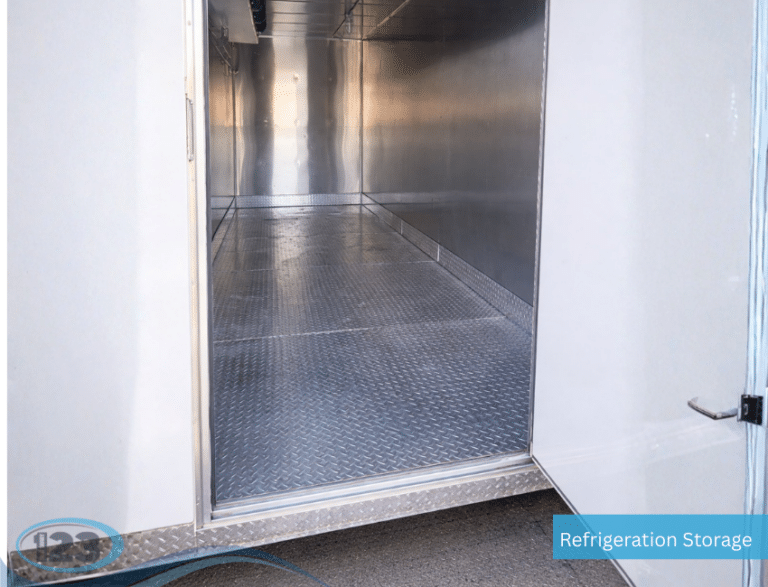
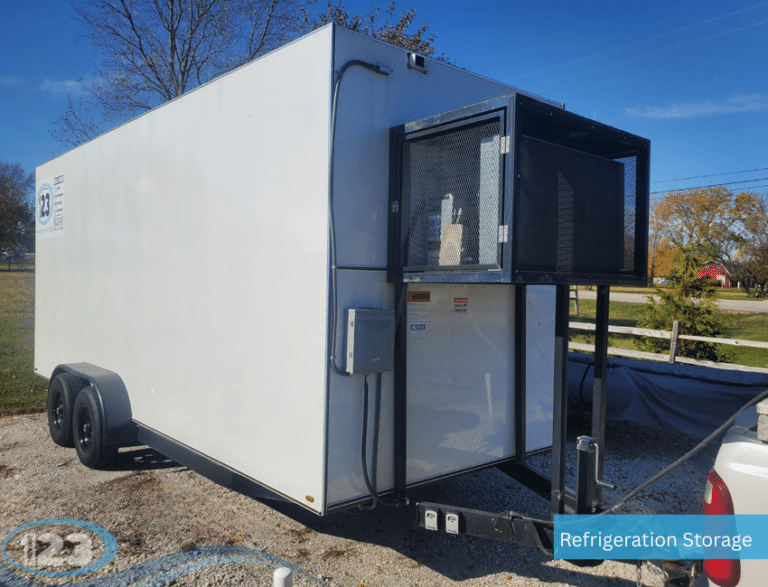
A documented 20-ft freezer trailer measures approximately 20 × 7 × 8 ft and weighs about 5,000 lb. That physical footprint makes delivery access and placement part of the transfer plan, not an issue to solve after the freezer arrives.
The comparable 20-ft refrigerated trailer is documented for approximately 6–8 standard pallets, depending on pallet dimensions. Do not assume all 8 pallet positions can be packed tightly when frozen-food access and airflow are important.
If additional storage is required, the master pricing material lists 20-ft refrigerated containers at $2,495–$2,995 and 40-ft refrigerated containers at $2,995–$3,995. The operating temperature of the actual selected container still needs to match the frozen-food requirement before loading.
What Does a Temporary Freezer Rental Cost?
The uploaded pricing guide lists a 20-ft freezer trailer at $1,495–$2,395. That range should remain intact in customer-facing content rather than being averaged into a different price.
| Equipment | Documented range |
|---|---|
| 12-ft refrigerated trailer | $1,295–$2,195 |
| 20-ft refrigerated trailer | $1,495–$2,395 |
| 20-ft freezer trailer | $1,495–$2,395 |
| 20-ft refrigerated container | $2,495–$2,995 |
| 40-ft refrigerated container | $2,995–$3,995 |
The master pricing material also states that these 5 rental categories do not automatically include freight, delivery, installation, fuel, utility connections, and other project-specific costs. A frozen-food transfer quote should therefore identify the complete installed scope.
By the Numbers
| Transfer-planning item | Figure |
| Frozen-food target | 0°F or below |
| Freezer trailer range | 0°F to -10°F |
| Electrical supply | 220V single phase |
| Amperage | 40–60 amps |
| Recommended breaker | 60 amps |
| Short cable guidance | 50 ft, 6 AWG |
| Suggested generator range | 25–30 kW |
| Approximate pallet capacity of similar 20-ft trailer | 6–8 pallets |
| Operational assistance | 24/7 |
These 9 figures cover the main temperature, power, cable, generator, capacity, and support issues involved in transferring frozen food into temporary storage.
How Do You Transfer Frozen Food Step by Step?
Use this 8-step transfer process.
- Identify the frozen inventory. Separate products that need to remain at 0°F or below from chilled products intended for a different refrigeration range.
- Position the rental freezer. Place the 20-ft unit close enough to the permanent freezer to reduce handling distance without blocking required delivery or operating access.
- Connect the electrical service. Verify approximately 220V single phase and 40–60 amps against the delivered unit’s nameplate.
- Pre-cool and test the unit. Confirm the freezer is holding 0°F or below before transferring the 1st case.
- Organize the loading sequence. Divide the inventory into several batches so the rental door is not held open for 1 continuous loading period.
- Load without blocking airflow. Do not pack cartons against the evaporator or return-air path even when using most of the available 6–8 pallet capacity.
- Record the operating temperature. Continue checking the unit after the transfer and investigate readings above 0°F according to the facility’s approved food-safety procedure.
- Keep backup storage active. Leave the rental freezer online until the permanent freezer is operating correctly and the final 1 return transfer is complete.
How Should Frozen Food Be Organized Inside the Rental Unit?
Frozen food should be covered, labeled, protected, and arranged so air can move through the load. The IcefoxEquipment sanitation material recommends at least 3 organizational zones for temporary cold storage: ready-to-eat products, raw products, and nonfood or packaging material.
That same principle applies during a frozen-food emergency. Put frequently used cases where employees can reach them quickly rather than forcing staff to move 6–8 pallet positions of product whenever they need a single carton.
Do not stack inventory directly against the evaporator or block its return-air path. The source material gives an example where the controller could display 38°F while a tightly packed corner remained warmer, illustrating why displayed temperature alone does not prove uniform air movement.
Why Is Door-Open Time So Important?
Every door opening allows warmer air into the freezer, and repeated access increases the refrigeration load. The supplied operating instructions specifically recommend keeping doors closed when a trailer is struggling to maintain its target temperature.
A controlled transfer should therefore use a staging sequence rather than leaving 2 freezer doors standing open while employees decide where products belong. Know the pallet, cart, rack, or zone destination before each load crosses the threshold.
Our preference is simple: use more short, organized transfers instead of 1 long open-door transfer. It is easier to control product location, airflow, and temperature when employees know the next batch before the rental freezer is opened.
How Does Electrical Power Affect the Transfer?
The documented 20-ft freezer or refrigeration trailer requires approximately 220V single phase at 40–60 amps. A power setup that repeatedly trips its breaker can interrupt refrigeration at the exact time a warm loading cycle is adding heat to the box.
Where the customer supplies the short electrical connection, the material specifies a 50-ft, 6 AWG cable. Longer runs have different documented conductor guidance: 4 AWG from 50–100 ft and 2 AWG from 100–200 ft.
The supplied guide also lists 3 possible connection arrangements: NEMA 6-50, cam lock, and hardwire. Confirm the actual delivered unit before buying connectors because not every trailer necessarily uses all 3.
Where utility power is unavailable, the source identifies approximately 25–30 kW as generator guidance for a 20-ft refrigerated or freezer trailer. Generator support is not automatically included with the rental and should be coordinated separately.
What Should You Do if Temperature Starts Rising?
An unexplained reading above 0°F for frozen product should trigger investigation rather than simply adjusting the log. The IcefoxEquipment source identifies common causes such as frequent door openings, blocked airflow, heavy loading, ice buildup, failed power, and incorrect controller settings.
Its corrective-action material uses a 5-step response: verify the reading, inspect the controller and operating conditions, move affected food to approved backup storage when required, record what happened, and determine product disposition under the facility’s approved food-safety procedure.
We would not repeatedly reset a 60-amp breaker and continue loading. Repeated electrical trips during a frozen-food transfer should stop the loading process long enough for the electrical supply and refrigeration system to be evaluated.
What Common Frozen-Food Transfer Mistakes Should You Avoid?
Mistake 1: Loading Before the Rental Freezer Is Cold
Do not move the 1st case simply because the rental trailer has arrived. Verify stable operation at 0°F or below first.
Mistake 2: Assuming 220V Means the Site Is Ready
A documented 20-ft freezer needs 40–60 amps, not merely a source labeled 220V. Verify phase, breaker, conductor, connector, and equipment nameplate.
Mistake 3: Packing Every Inch of the Trailer
A 20-ft unit with space for approximately 6–8 pallets still needs airflow. Blocking the evaporator or return path can create uneven temperatures.
Mistake 4: Moving Everything at Once
A single 1-stage transfer can keep doors open unnecessarily and make inventory organization harder. Use planned batches with predetermined storage locations.
Mistake 5: Disconnecting the Rental Too Soon
Keep IcefoxEquipment temporary storage active until the permanent freezer has returned to 0°F or below and the final product transfer has been completed.
What Should Be on the Frozen-Food Transfer Checklist?
- ☐ Confirm the rental unit is holding 0°F or below.
- ☐ Verify the freezer’s documented range can reach 0°F to -10°F.
- ☐ Confirm 220V single-phase electrical service.
- ☐ Confirm the delivered unit requires approximately 40–60 amps.
- ☐ Check the documented 60-amp breaker recommendation against the nameplate.
- ☐ Inspect the 50-ft, 6 AWG cable when using the documented short connection.
- ☐ Plan product zones before loading the 1st case.
- ☐ Leave airflow around the stored 6–8 pallet load where applicable.
- ☐ Record temperature throughout the transfer.
- ☐ Keep IcefoxEquipment’s 24/7 support number, 800-245-5216, available.
The strongest operational rule is to test first and transfer second. Losing 1 loading window while correcting a power issue is generally cleaner than discovering the problem after a 20-ft freezer has already been filled with product.
Request a Quote
Request a quote today for industry-leading refrigeration, modular facilities, and mobile equipment solutions. Ice Fox Equipment provides rapid deployment, flexible rental and leasing options, and dependable support for construction, healthcare, food service, emergency response, and industrial operations. Contact our team now for a customized, no-obligation quote.

Frequently Asked Questions
Frozen food should generally remain at 0°F or below during temporary storage. The uploaded IcefoxEquipment pricing material lists a 20-ft freezer trailer with an operating range of approximately 0°F to -10°F. Confirm the actual unit temperature before loading and continue monitoring after the transfer begins.
The supplied pricing guide lists the 20-ft freezer trailer at $1,495–$2,395. IcefoxEquipment project pricing can also involve freight, installation, electrical connections, generators, and other logistics. The comparable 20-ft refrigerated trailer is listed at the same $1,495–$2,395 planning range.
A documented IcefoxEquipment-style 20-ft freezer trailer uses approximately 220V single-phase power at 40–60 amps, with a 60-amp breaker recommendation in the supplied power material. A customer-supplied short run may use a 50-ft, 6 AWG connection, subject to the actual delivered unit.