
How Do Supermarkets Preserve Produce in Outages? IcefoxEquipment Explains
Article Plans
Supermarkets preserve produce during power outages by limiting cooler-door traffic, monitoring temperatures, separating vulnerable inventory, supplying backup power, and transferring food into temporary refrigerated storage. IcefoxEquipment supplies mobile walk-in coolers, refrigerated trailers, reefer containers, and generator support for emergency cold-chain continuity across the United States.
An outage response should begin within the first 30 minutes, not after displays feel warm or condensation appears on packaged produce. IcefoxEquipment notes that a refrigeration interruption lasting from 30 minutes to 4 hours can quickly develop into product loss, regulatory exposure, and supply-chain disruption.
Quick Answer: Supermarkets protect produce during outages by closing cooler doors, documenting temperatures, moving priority inventory into temporary refrigeration, and powering that equipment with an approved source. A 20-foot refrigerated trailer can hold 6–8 standard pallets, operates within a documented 34°F–41°F range, and has a planning price of $1,495–$2,395.
Quick Facts
- IcefoxEquipment maintains a 24/7 emergency telephone line for urgent refrigeration requests.
- A 12-foot refrigerated trailer has a documented planning range of $1,295–$2,195.
- A 20-foot refrigerated trailer holds approximately 6–8 standard pallets.
- A 40-foot reefer container provides approximately 2,200–2,400 cubic feet.
- Refrigeration-trailer power may require 220V, single phase, and 40–60 amps.
- IcefoxEquipment lists refrigeration service coverage across 50 US states.
Key Takeaways
- Begin the produce-protection plan during the first 30 minutes of a refrigeration outage.
- Use a 12-foot trailer for limited overflow and a 20-foot or 40-foot unit for larger transfers.
- Confirm whether the delivered trailer needs 40 amps or 40–60 amps before connecting power.
- Keep doors closed and organize each transfer so the cooler is not repeatedly opened for 1 item.
- Projects exceeding 6, 12, or 24 months may qualify for preferred rental pricing.
What Should a Supermarket Do First During an Outage?
The first action is to stabilize the existing cold environment for at least 1 organized assessment period. Close walk-in doors, reduce access to refrigerated back rooms, stop unnecessary stocking activity, and assign one manager to coordinate temperature records and product movement.
Do not immediately open every display and walk-in to inspect the contents. Every 1 unnecessary opening releases conditioned air and makes the next recovery cycle harder, especially when store temperatures rise during a summer outage.
Create at least 3 inventory groups: produce that must remain refrigerated, produce that can tolerate temporary staging under the store’s approved procedures, and inventory already showing quality concerns. This prevents employees from treating every carton, case, and pallet as if it has the same storage requirement.
Our practical view is that the first 30 minutes should be spent organizing, not improvising. A rushed transfer without pallet counts, temperature priorities, and a destination often leaves the most vulnerable inventory sitting on the dock while less urgent stock occupies the emergency cooler.
How Does Temporary Refrigeration Protect Produce?
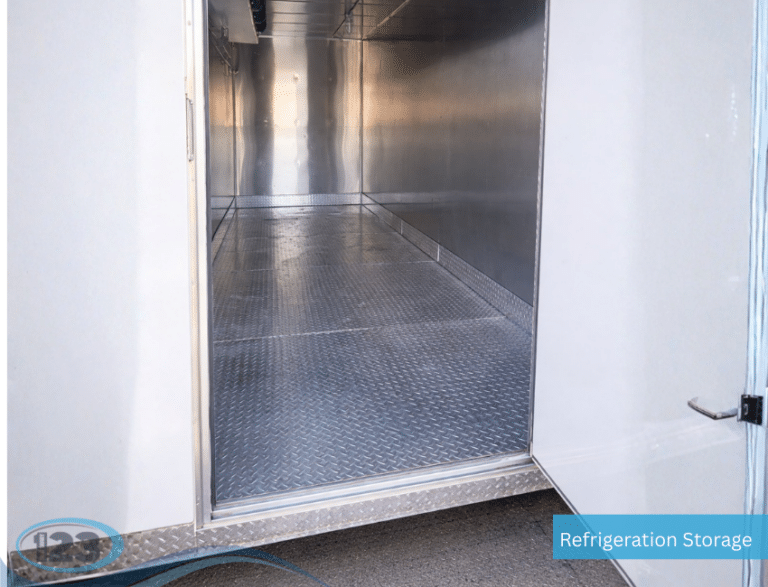
Temporary refrigeration creates replacement capacity when a supermarket’s permanent walk-in, rooftop system, electrical service, or refrigerated cases are unavailable. IcefoxEquipment identifies mobile walk-in coolers as suitable for supermarkets and emergency backup applications, with portable construction and precise temperature control.
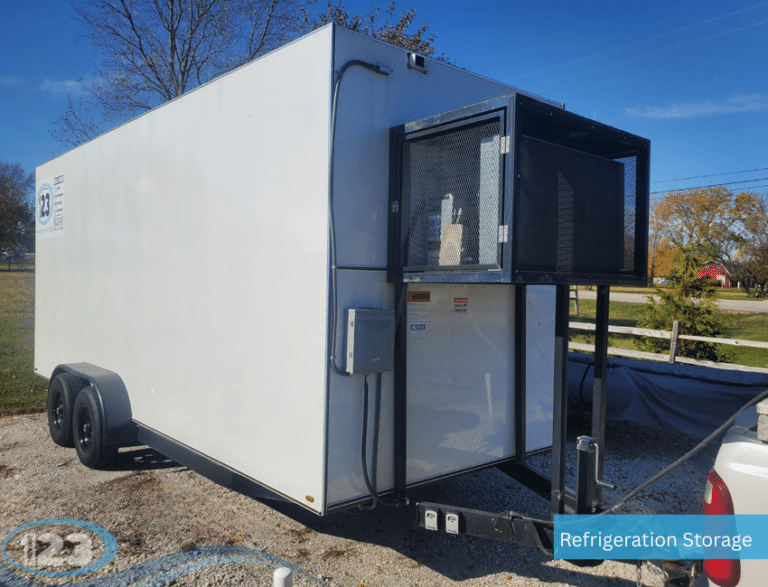
A supermarket can use a 12-foot refrigerated trailer for a limited department, receiving overflow, or smaller outage. The uploaded fleet guide lists 70–80 cubic feet of usable storage and a planning rental range of $1,295–$2,195.
A 20-foot refrigerated trailer provides space for approximately 6–8 standard pallets and has a documented planning range of $1,495–$2,395. This option can support a produce department while leaving permanent cold rooms available for meat, dairy, prepared food, or other protected categories.
For larger transfers, a 20-foot reefer container provides approximately 1,000–1,100 cubic feet, while a 40-foot container provides approximately 2,200–2,400 cubic feet. The documented planning ranges are $2,495–$2,995 and $2,995–$3,995, respectively.
By the Numbers: Emergency Produce Storage
| Planning factor | Sourced figure | Operational use |
|---|---|---|
| Initial risk window | 30 minutes to 4 hours | Begin response and transfer planning |
| 12-foot trailer capacity | 70–80 cubic feet | Limited department or small overflow |
| 20-foot trailer capacity | 6–8 standard pallets | Moderate produce inventory |
| 20-foot container capacity | 1,000–1,100 cubic feet | Larger store or longer outage |
| 40-foot container capacity | 2,200–2,400 cubic feet | High-volume supermarket inventory |
| Cooler operating range | 34°F–41°F | Refrigerated product storage |
| Trailer power | 220V, 40–60 amps | Electrical planning |
| Quote response | Within 1 hour | Early emergency procurement |
These 8 figures should be treated as planning inputs, not a substitute for the delivered unit’s specifications. The final equipment selection depends on pallet count, product mix, outage duration, delivery access, store ZIP code, power availability, and the supermarket’s food-safety procedures.
How Should You Prioritize Produce for Transfer?
Transfer priority should be based on the store’s documented handling requirements and current product condition, using at least 3 clearly labeled zones. Place the most temperature-sensitive inventory in the first zone, stable unopened cases in the second, and items requiring inspection in the third.
Count pallets before requesting equipment. A supermarket expecting 7 pallets should not reserve a 12-foot trailer with only 70–80 cubic feet simply because it has the lowest monthly price.
Organize produce by department and retrieval sequence before loading. If the morning team needs 1 pallet of leafy greens first, do not place it behind 6 pallets of slower-moving inventory.
Most stores lose efficiency by packing the emergency unit to its theoretical maximum. We recommend preserving at least 1 usable aisle or access route, because a tightly packed trailer encourages longer door openings and repeated handling.
What Temperature Should the Temporary Cooler Maintain?
The uploaded pricing guide lists a refrigerated-trailer operating range of 34°F–41°F. The actual set point must follow the supermarket’s approved product specifications and the requirements for the produce being stored.
IcefoxEquipment lists equipment capable of operating from -20°F to 50°F, but that broad equipment range does not mean every produce item belongs at the same setting. The selected unit and thermostat must be matched to the inventory assigned to it.
Assign at least 1 employee per shift to record the displayed temperature and report alarms, breaker trips, or unusual cycling. The log should identify the date, time, unit, reading, and corrective action under the store’s existing food-safety program.
Avoid using the temporary cooler as a sorting room. Employees who enter the trailer 10 separate times to retrieve small orders create more heat infiltration than a team that stages the entire pick before opening the door once.
What Power Does a Refrigeration Trailer Require?
The uploaded setup instructions specify 220V, single-phase service at 40–60 amps, with 50–60 amps preferred where breakers repeatedly trip. A separate uploaded power guide lists 220V, single phase, and 40 amps for 12-foot freezer and 20-foot refrigerated trailers.
These figures show why the exact data plate on the delivered unit must control the connection. Never assume that 2 refrigeration trailers use the same breaker, receptacle, cable, or startup load.
When a rented cable is not included, the setup document specifies a 50-foot, 6-AWG extension cable and a licensed commercial electrician on site. Longer distances, alternate voltage, or generator use require project-specific confirmation before energizing the unit.
In the setup document’s normal operating sequence, the compressor may cycle 3 times and run on the 4th cycle, with the fans starting when the unit reaches 55°F. Staff should not repeatedly reset power without first confirming whether the unit is following its documented startup or defrost process.
IcefoxEquipment also provides generator solutions for emergency sites, blackouts, and remote operations across the USA. Review IcefoxEquipment generator options while confirming the exact refrigeration load with the project coordinator.
Step-by-Step: How Do You Move Produce Into Emergency Refrigeration?
Use this 7-step process to maintain an orderly cold-chain response.
- Start the outage log. Record the outage time and begin the first assessment within 30 minutes.
- Close cold-storage doors. Permit access through 1 designated employee or team.
- Count the inventory. Document pallets, cases, rolling racks, and department ownership before selecting a 12-foot, 20-foot, or 40-foot unit.
- Confirm the set point. Match the temporary cooler to the documented 34°F–41°F refrigerated range and the product requirements.
- Verify power. Arrange the required 220V, 40–60-amp connection or an approved generator.
- Pre-stage the load. Organize all 6–8 pallets, when applicable, before opening the temporary trailer.
- Monitor each shift. Assign at least 1 person to review temperature, power, door condition, and alarms.
Call 800-245-5216 once the store has the ZIP code, pallet count, required temperature, delivery route, connection details, and expected outage duration. IcefoxEquipment advertises 24/7 emergency telephone availability and quotes within 1 hour.
What Site Access Does the Delivery Team Need?
The uploaded fleet guide calls for a minimum 12-foot gate, 14 feet of vertical clearance, and approximately 60 feet of turning room. These dimensions should be checked before dispatch so the delivery vehicle does not arrive at a blocked or undersized service entrance.
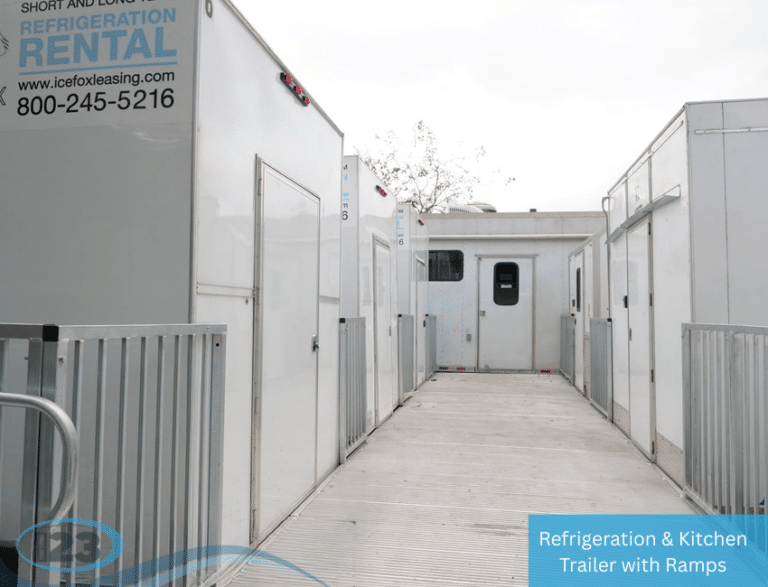
A refrigeration trailer may have a floor 24–36 inches above grade. Plan stairs, a platform, or a suitable ramp before employees begin moving carts and cases into the unit.
Place the temporary cooler on a stable, level surface close to receiving but outside the normal path of delivery trucks. Saving 20 feet of walking distance is not useful when the trailer blocks compactor access, fire lanes, or daily vendor movement.
Protect the electrical cable across its full 50-foot route. Do not leave it exposed beneath pallet jacks, produce carts, standing water, vehicle tires, or sharp dock edges.
What Common Outage Mistakes Should Supermarkets Avoid?
Mistake 1: Waiting for Produce to Feel Warm
A refrigeration problem can escalate within 30 minutes to 4 hours. Begin documentation and equipment calls before visible product deterioration appears.
Mistake 2: Renting the Smallest Unit
A 12-foot trailer may cost less, but it cannot replace the 6–8-pallet capacity of a 20-foot trailer. Select by peak inventory, not the lowest line-item price.
Mistake 3: Assuming the Store Has the Right Receptacle
The trailer may require 220V and 40–60 amps. Confirm phase, breaker, connector, grounding, and cable length before delivery.
Mistake 4: Opening the Trailer Repeatedly
Use 1 staged transfer plan instead of sending individual employees into the cooler throughout the hour. Frequent door movement reduces temperature stability and increases handling time.
Mistake 5: Ignoring Summer Conditions
The setup document identifies 3 hot-weather responses: remove ice buildup from coils, keep doors closed, and raise available amperage to 60 amps when authorized and appropriate for the equipment.
Supermarket Outage Decision Checklist
- ☐ Record the outage start time and assess conditions within 30 minutes.
- ☐ Divide produce into at least 3 priority groups.
- ☐ Count pallets before choosing a 12-foot, 20-foot, or 40-foot unit.
- ☐ Confirm the documented 34°F–41°F refrigeration range.
- ☐ Verify 220V, single-phase, 40–60-amp service.
- ☐ Arrange a 50-foot, 6-AWG cable when required.
- ☐ Confirm a 12-foot gate and 14-foot vertical clearance.
- ☐ Reserve approximately 60 feet for delivery maneuvering.
- ☐ Plan safe access to a floor 24–36 inches above grade.
- ☐ Assign 1 temperature-log owner per shift.
- ☐ Ask about preferred pricing for 6-, 12-, or 24-month projects.
- ☐ Save the IcefoxEquipment emergency number: 800-245-5216.
Request a Quote
Request a quote today for industry-leading refrigeration, modular facilities, and mobile equipment solutions. Ice Fox Equipment provides rapid deployment, flexible rental and leasing options, and dependable support for construction, healthcare, food service, emergency response, and industrial operations. Contact our team now for a customized, no-obligation quote.

Frequently Asked Questions
Yes. IcefoxEquipment supplies mobile walk-in coolers, refrigerated trailers, freezer trailers, and reefer containers for supermarket emergencies. The company advertises a 24/7 emergency line and coverage across 50 US states. Store teams should provide the ZIP code, required temperature, pallet count, power details, and site-access information.
Documented planning prices start at $1,295–$2,195 for a 12-foot refrigerated trailer. A 20-foot refrigerated trailer is listed at $1,495–$2,395, while a 40-foot reefer container is listed at $2,995–$3,995. Final costs depend on freight, duration, setup, power, site services, and availability.
The correct size depends on peak pallet count and outage duration. A 12-foot trailer provides 70–80 cubic feet, a 20-foot trailer holds approximately 6–8 pallets, and a 40-foot reefer container provides about 2,200–2,400 cubic feet. Choose enough capacity to retain an accessible loading aisle.