
How Do I Size a Walk-In Cooler Rental? IcefoxEquipment Planning Guide
Article Plans
Sizing a walk-in cooler rental starts with the inventory you must hold at one time, not the amount you receive over an entire week. IcefoxEquipment offers 12-foot and 20-foot refrigerated trailers plus 20-foot and 40-foot reefer containers for temporary cold-storage needs across the United States.
The practical choices range from a 12-foot trailer with a 4,000-pound planning weight to a 40-foot container with approximately 2,200–2,400 cubic feet of capacity. The right unit must hold your peak inventory while preserving door access, airflow, pallet handling, and safe temperatures between 34°F and 41°F.
Quick Answer: Size a walk-in cooler rental by counting your maximum pallets, cases, racks, and carts on the busiest operating day. A 12-foot trailer may support approximately 3–5 pallets, a 20-foot trailer approximately 6–8 pallets, and a 40-foot refrigerated container approximately 20–24 pallets, depending on load dimensions.
Quick Facts
- A 12-foot refrigerated trailer measures 12 feet by 7 feet by 8 feet.
- A 20-foot refrigerated trailer measures 20 feet by 7 feet by 8 feet.
- A 20-foot trailer holds approximately 6–8 standard pallets, depending on pallet size.
- A 20-foot reefer container provides approximately 1,000–1,100 cubic feet.
- A 40-foot reefer container provides approximately 2,200–2,400 cubic feet.
- Refrigerated trailers are listed for a temperature range of 34°F–41°F.
Key Takeaways
- Size the rental around your 1 highest inventory day, not an average day.
- Count floor positions, pallet dimensions, shelving, carts, and clear aisles before selecting a 12-, 20-, or 40-foot unit.
- Choose a 20-foot trailer when approximately 6–8 pallet positions match your peak storage requirement.
- Select a 40-foot reefer container when capacity approaches 20–24 pallets or 2,200–2,400 cubic feet.
- Confirm the site can provide the assigned unit’s 220V, 40–60-amp electrical service before delivery.
What Information Do You Need Before Choosing a Cooler Size?
You need a physical inventory count, delivery schedule, product temperature, storage method, and project duration. Those 5 inputs are more useful than telling a rental company that your existing cooler is merely “large” or “small.”
Start by recording the maximum number of pallets, cases, rolling racks, carts, barrels, totes, or ingredient bins that must remain inside at the same time. A 20-foot refrigerated trailer may hold 6–8 standard pallets, but that count falls when loads use oversized pallets, deep shelving, or wide transport carts.
Next, measure your largest item and the path it must travel through the cooler. The uploaded documents identify a 42-inch door opening on a 20-foot trailer, which can become the controlling measurement even when the interior has enough total volume.
Finally, calculate how often inventory turns. A kitchen receiving food 1 time each week generally needs more peak storage than a kitchen receiving smaller deliveries several times within the same 7-day period.
Should You Size by Pallets or Cubic Feet?
Use pallet positions when most inventory arrives on pallets, and use cubic feet when products are stored on shelving, racks, or carts. The most accurate plan uses both measurements because usable floor space and total air volume describe different constraints.
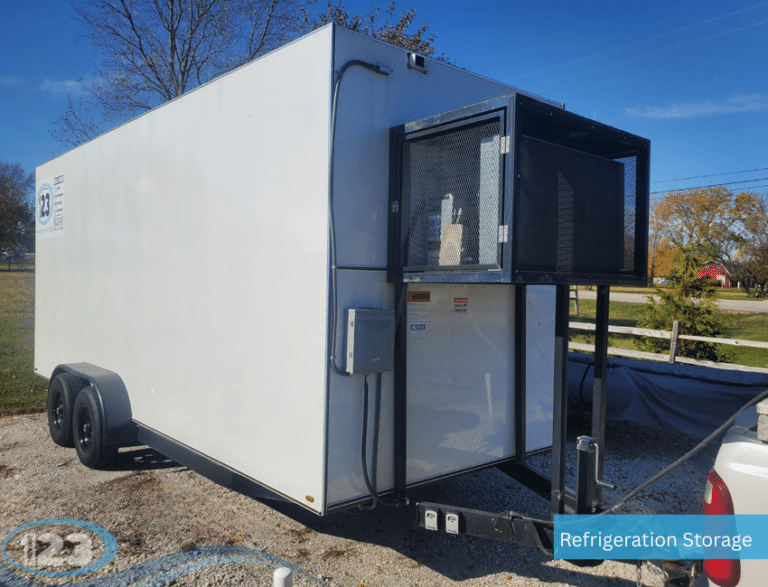
A small 12-foot refrigeration trailer is described in IcefoxEquipment’s electrical checklist as holding approximately 3–5 pallets. The uploaded fleet guide separately lists 70–80 cubic feet of usable storage for a 12-foot trailer, a figure that should be verified against the specific delivered unit because shelving and interior equipment affect usable volume.
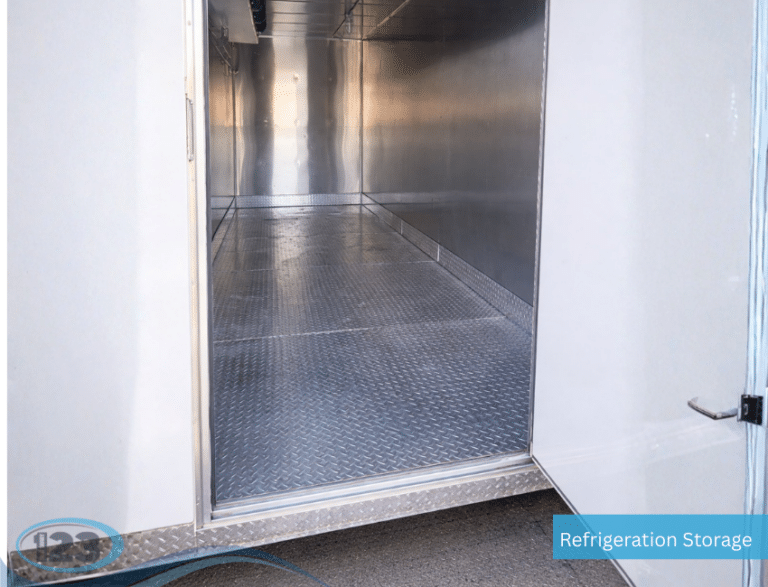
A 20-foot refrigerated trailer provides approximately 6–8 standard pallet positions. This option is often easier to plan when deliveries arrive on conventional pallets and staff can preserve at least 1 clear access path from the door to the rear inventory.
The 20-foot reefer container provides approximately 1,000–1,100 cubic feet, while the 40-foot container provides approximately 2,200–2,400 cubic feet. Those container sizes suit operations that need substantially more floor area, high-density shelving, or longer inventory cycles.
How Much Space Does Each IcefoxEquipment Option Provide?
The right choice depends on the storage method, but the uploaded fleet data creates 4 practical size tiers.
| Rental option | Physical size | Documented capacity | Listed rental range |
| 12-foot refrigerated trailer | 12 ft × 7 ft × 8 ft | Approx. 3–5 pallets; fleet guide also lists 70–80 usable cubic feet | $1,295–$2,195 |
| 20-foot refrigerated trailer | 20 ft × 7 ft × 8 ft | Approx. 6–8 standard pallets | $1,495–$2,395 |
| 20-foot reefer container | 20 ft × 8 ft × 9 ft | Approx. 1,000–1,100 cubic feet | $2,495–$2,995 |
| 40-foot reefer container | 40 ft × 8 ft 6 in × 9 ft | Approx. 2,200–2,400 cubic feet or 20–24 pallets | $2,995–$3,995 |
The 12-foot option is the most compact of the 4 tiers. It works best when your inventory count is stable, deliveries are frequent, and the operation does not need wide internal aisles or multiple rolling racks.
The 20-foot trailer is a practical middle choice because its documented 6–8-pallet capacity provides more flexibility without moving into a full reefer-container footprint. In our experience, this is often the safer starting point when the 12-foot option looks adequate only after every case is packed tightly.
The 20-foot reefer container has approximately 1,000–1,100 cubic feet of interior capacity and is 8 feet wide rather than 7 feet. That extra 1 foot of width can matter when you need opposing shelving, pallet-jack movement, or a wider center aisle.
The 40-foot container offers approximately 2,200–2,400 cubic feet and may hold 20–24 pallets. It is designed for high-volume inventory, but the site must also accommodate a 40-foot-long unit, delivery equipment, electrical access, and operating clearance.
How Should Peak Inventory Affect Cooler Sizing?
Peak inventory is the largest quantity stored during any 1 operating cycle. That number should control the rental size because a cooler that works on ordinary days can fail operationally immediately after a large delivery.
Review at least 3 inventory points: the quantity before delivery, the quantity immediately after delivery, and the quantity during the busiest production period. The highest of those 3 counts is the baseline storage requirement.
Then account for products that cannot be stacked. Delicate produce, prepared trays, bakery racks, medical cartons, floral inventory, and open food containers may consume 2 times the floor area of tightly stacked cases even when their total product volume is similar.
We recommend leaving working clearance instead of filling every documented pallet position. If a 20-foot trailer technically holds 8 pallets, choosing it for an operation that requires exactly 8 pallet positions leaves no practical margin for sorting, rejected product, late deliveries, or aisle access.
How Do Shelving and Aisles Change the Required Size?
Shelving increases vertical use but reduces clear width and turning space. A 7-foot-wide trailer with shelves on 2 sides will have less usable center-aisle width than the exterior dimensions suggest.
Measure the depth of each shelf and cart before selecting the unit. Two shelves that are each 24 inches deep consume 48 inches of combined width before accounting for the center aisle, wall thickness, evaporator equipment, or product overhang.
Rolling bakery racks and food-service carts need clear door and turning dimensions. A 42-inch door opening may accept a narrow rack but reject a wide pallet or cart even when the internal cooler capacity is sufficient.
This is why we do not recommend sizing from cubic feet alone. A 20-foot container with 1,000–1,100 cubic feet can be operationally superior to a tightly packed trailer if it provides the width needed for 1 usable aisle and safe stock rotation.
Does Product Type Change the Cooler Size?
Yes. Product type changes the spacing, stacking, temperature, airflow, and access requirements. Refrigerated trailers in the uploaded price guide operate at 34°F–41°F, but products stored within that range may require very different layouts.
Boxed beverages and sealed ingredients can often be stacked more densely than fresh produce. Produce requires space for air movement, and blocking 1 evaporator discharge path can create uneven interior temperatures.
Prepared food, patient meals, catering trays, and bakery racks require frequent door access. A unit that holds the correct case count may still be undersized if workers must unload 3 racks to reach the rack needed for the next service period.
For mixed inventory, divide products into at least 3 zones before calculating the final size: high-turn stock near the entrance, reserve stock farther inside, and fragile or restricted items in designated rack or shelf positions.
How Does Delivery Frequency Affect Sizing?
More frequent deliveries can reduce required storage, while less frequent deliveries increase peak volume. A business receiving 7 days of inventory at once needs more capacity than the same business receiving smaller deliveries every 2 or 3 days.
Do not reduce the cooler size until the delivery schedule is confirmed in writing. A plan based on 3 weekly deliveries fails when vendors can guarantee only 1 delivery each week during a renovation or emergency.
Seasonal peaks also matter. A supermarket, university, brewery, hospital, or caterer may carry 2 separate inventory levels: ordinary operating stock and holiday, event, outage, or construction stock.
Our opinion is simple: rent for the confirmed peak rather than the hoped-for average. The monthly difference between a 12-foot trailer at $1,295–$2,195 and a 20-foot trailer at $1,495–$2,395 can be smaller than the cost of relocating inventory after the first delivery.
What Site Space Is Required Around the Cooler?
The operating site must accommodate the unit’s physical length, delivery path, doors, stairs or ramps, electrical cable, condenser airflow, and service access. A 20-foot trailer needs more than a bare 20-foot strip of ground.
The site must support a 4,000-pound trailer for the 12-foot option or approximately 5,000 pounds for the 20-foot trailer. The ground should remain stable under the unit, delivery vehicle, and normal loading activity.
Leave the refrigeration machinery unobstructed. Blocking the condenser with fencing, pallets, temporary walls, or another trailer on 1 side can interfere with heat rejection and cooling performance.
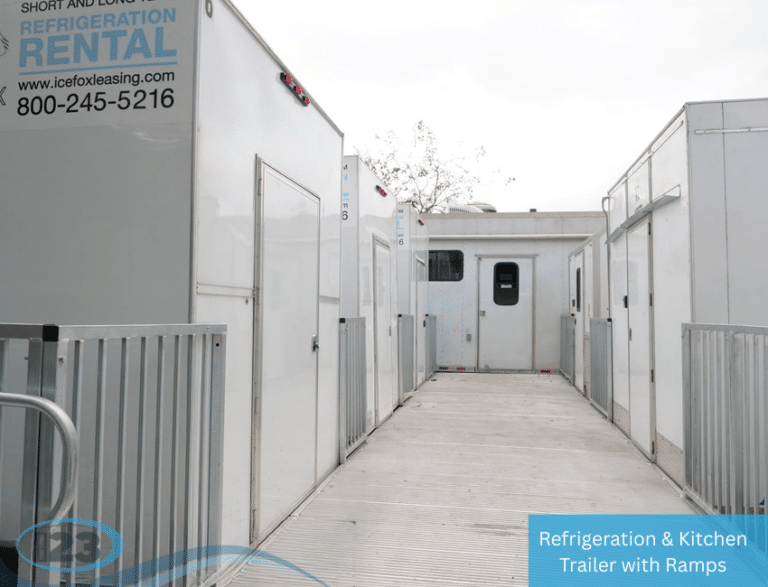
Plan the door area as a working zone, not wasted space. Staff need room for at least 1 cart, pallet jack, or rack outside the door without blocking stairs, ramps, traffic lanes, or the electrical connection.
What Power Is Needed for the Selected Size?
The assigned equipment determines the final electrical requirement. Uploaded setup documents identify 220V, single-phase service at 40–60 amps for refrigeration trailers.
Another uploaded power guide lists 220V, single-phase, 40 amps for 12-foot freezer and 20-foot refrigeration trailers. Because different models may use different refrigeration packages, the nameplate and written unit specification must control.
When a rental cord is not provided, the setup guide calls for a 50-foot, 6-AWG extension cord and a licensed commercial electrician. The electrical distance can therefore influence placement even when the cooler physically fits elsewhere on the site.
IcefoxEquipment advises matching equipment size to available power because a 40-foot container holding 20–24 pallets may require greater electrical capacity than a smaller 12-foot trailer.
By the Numbers
| Planning measurement | Sourced figure |
| Small trailer length | 12 feet |
| Medium trailer pallet capacity | 6–8 pallets |
| 20-foot container volume | 1,000–1,100 cubic feet |
| 40-foot container volume | 2,200–2,400 cubic feet |
| Large-container pallet capacity | 20–24 pallets |
| Refrigerated operating range | 34°F–41°F |
| Trailer electrical range | 40–60 amps |
| Standard support availability | 24/7 |
These 8 figures provide a starting framework, but your final selection should be based on measured inventory, the actual product layout, and the specification of the assigned unit.
How Do You Size a Walk-In Cooler Rental Step by Step?
Use this 7-step process to turn inventory information into a defensible size selection.
- Count peak inventory. Record the highest number of pallets, cases, racks, carts, bins, or barrels held during any 1 delivery cycle.
- Measure the largest load. Record the width, depth, and height of the largest pallet, cart, or rack, including any load overhang.
- Check door access. Compare the largest load with the documented 42-inch opening used by certain 20-foot trailers.
- Draw the interior layout. Place shelving, pallets, carts, evaporator clearance, and at least 1 continuous access aisle on a simple plan.
- Compare the 4 equipment tiers. Review the 12-foot trailer, 20-foot trailer, 20-foot container, and 40-foot container.
- Confirm site and power. Verify stable ground, delivery access, airflow, and the assigned 220V, 40–60-amp requirement.
- Add operating margin. Choose the next size when the projected load consumes all documented pallet positions or leaves fewer than 1 workable aisle.
For help matching inventory to a unit, submit your pallet count, case dimensions, temperature, ZIP code, and rental dates through IcefoxEquipment rental support.
What Common Sizing Mistakes Should You Avoid?
Mistake 1: Using Daily Usage Instead of Peak Storage
A kitchen may use 1 pallet per day but hold 7 pallets after a weekly delivery. Size for the 7-pallet peak, not the 1-pallet daily withdrawal.
Mistake 2: Counting Pallets Without Measuring Them
The 20-foot trailer’s 6–8-pallet estimate depends on pallet dimensions. Oversized, overhanging, or irregular loads reduce the actual count.
Mistake 3: Ignoring the Door Opening
A load wider than the documented 42-inch opening cannot enter merely because the interior has enough cubic capacity.
Mistake 4: Filling Every Available Position
Selecting a trailer for exactly 8 pallets when its documented range is 6–8 leaves little room for aisles, late deliveries, sorting, or stock rotation.
Mistake 5: Forgetting Electrical Capacity
A cooler sized for 20–24 pallets is not deployable if the site cannot provide the voltage, phase, amperage, and connection required by the assigned equipment.
Walk-In Cooler Rental Decision Checklist
- ☐ Record the maximum inventory held during 1 complete delivery cycle.
- ☐ Count pallets, racks, carts, cases, bins, and barrels separately.
- ☐ Measure the largest item against the 42-inch door-opening reference.
- ☐ Confirm whether the load fits a 3–5-, 6–8-, or 20–24-pallet tier.
- ☐ Compare 1,000–1,100 cubic feet with 2,200–2,400 cubic feet when considering containers.
- ☐ Preserve at least 1 clear aisle from the door to frequently used inventory.
- ☐ Verify the site supports a 4,000- or 5,000-pound trailer where applicable.
- ☐ Confirm 220V, single-phase, 40–60-amp power for the assigned trailer.
- ☐ Determine whether a 50-foot, 6-AWG cord is included.
- ☐ Include seasonal, emergency, and delivery-delay stock in the peak count.
- ☐ Compare the $1,295–$2,195 and $1,495–$2,395 trailer price ranges.
- ☐ Call 800-245-5216 before finalizing the unit.
Request a Quote
Request a quote today for industry-leading refrigeration, modular facilities, and mobile equipment solutions. Ice Fox Equipment provides rapid deployment, flexible rental and leasing options, and dependable support for construction, healthcare, food service, emergency response, and industrial operations. Contact our team now for a customized, no-obligation quote.
Frequently Asked Questions
IcefoxEquipment’s sourced options include 12-foot and 20-foot refrigerated trailers plus 20-foot and 40-foot reefer containers. The 20-foot trailer holds approximately 6–8 standard pallets, while a 40-foot container may hold approximately 20–24 pallets, depending on pallet dimensions and interior layout.
A small 12-foot refrigeration trailer may support approximately 3–5 pallets, while the uploaded fleet guide lists 6–8 standard pallets for a 20-foot refrigerated trailer. Actual capacity depends on pallet dimensions, door clearance, shelving, airflow, evaporator placement, and the aisle needed for safe inventory access.
The uploaded pricing guide lists a 12-foot refrigerated trailer at $1,295–$2,195 and a 20-foot trailer at $1,495–$2,395. A 20-foot reefer container is listed at $2,495–$2,995, while a 40-foot container is listed at $2,995–$3,995.