
How to Pass Health Department Cold Storage Audits With IcefoxEquipment
Article Plans
A successful cold-storage audit depends on documented temperature control, clean equipment, protected food, reliable power, and staff who can explain what happened when a reading went outside its limit. IcefoxEquipment helps facilities prepare temporary refrigeration through commercial walk-in refrigeration solutions supported by 24/7 assistance, but the local operator remains responsible for meeting the inspecting authority’s requirements.
Passing an audit is not about making the trailer look clean for 1 inspection hour. The inspector needs evidence that the cold chain was controlled before, during, and after each operating shift, including temperature records, cleaning logs, corrective actions, food separation, power stability, and equipment condition.
Quick Answer
To pass a health department cold-storage audit, maintain refrigerated food at 41°F or below and frozen food at 0°F or below, document readings, keep food separated and covered, clean the unit daily, verify doors and gaskets, and record every corrective action. Confirm local inspection procedures before beginning operation.
Quick Facts
- Refrigerated food should generally remain at 41°F or below.
- Frozen products should generally remain at 0°F or below.
- A common IcefoxEquipment refrigerated-trailer connection requires 220V, single-phase, 40–60 amps.
- A customer-supplied connection may require a 50-foot, 6 AWG cord and a licensed electrician.
- Temporary refrigeration sanitation guidance addresses documented control throughout a 5-day deployment.
- IcefoxEquipment provides operational support 24 hours a day, 7 days a week.
Key Takeaways
- A single reading of 41°F or below does not replace a continuous temperature log showing the unit remained controlled throughout operation.
- Frozen inventory should generally remain at 0°F or below, with every deviation documented and evaluated.
- A 220V, single-phase, 40–60-amp supply must remain stable enough to prevent repeated refrigeration interruptions.
- Daily cleaning during a 5-day deployment should include walls, floors, door hardware, shelving, and spill areas.
- The operator should confirm local inspection and scheduling requirements before the planned inspection date.
What Does a Health Inspector Review in Cold Storage?
A health inspector generally reviews temperature control, food protection, cleanable surfaces, sanitation practices, contamination prevention, equipment condition, and operating records. IcefoxEquipment’s compliance materials identify these as central concerns for temporary refrigerated storage, although the exact checklist varies by jurisdiction.
Inspectors may also ask who is responsible for checking temperatures, what occurs after an out-of-range reading, how the unit is cleaned, how raw products are separated, and what backup plan applies after a power failure. Keep the facility’s approved procedures and locally required forms available for review.
In our experience, operators often focus too heavily on the displayed temperature and not enough on the written record. A display showing 38°F at inspection time cannot prove that food remained controlled during the previous shift, overnight period, delivery, or loading process.
How Should Temperature Records Be Maintained?
Temperature logs should identify the date, time, actual reading, unit or zone, employee initials, and corrective action. Refrigerated inventory should generally remain at 41°F or below, while frozen inventory should generally remain at 0°F or below.
The required monitoring interval may vary by health authority, facility policy, product type, and approved food-safety plan. Follow the frequency established for your operation and apply it consistently throughout every shift.
A useful log should contain at least 6 fields:
- Date of the reading.
- Exact time of the reading.
- Refrigeration unit or storage zone.
- Actual temperature in °F.
- Name or initials of the employee.
- Corrective action when the reading exceeds the approved limit.
Electronic monitoring can strengthen documentation when it provides real-time readings and automated alerts, but a digital system must still be reviewed by a responsible employee. IcefoxEquipment notes that modern refrigerated equipment may include tracking, monitoring, and alert functions across a range of -20°F to 70°F.
What Temperature Problems Must Be Corrected Before an Audit?
Any unexplained reading above 41°F for refrigerated food or above 0°F for frozen products should be evaluated before inspection. The response should identify the cause, affected product, duration, corrective action, and person who approved the final disposition.
Common causes include frequent door openings, blocked airflow, heavy loading, ice accumulation, failed power, an incorrect controller setting, or a warm product load. High-traffic locations are especially vulnerable because repeated door openings allow warm air to enter the refrigerated space.
We recommend against simply deleting a bad reading or writing a cleaner number over it. A documented 1-time deviation with a credible corrective action is easier to defend than a suspicious log containing only perfect readings.
How Should an Out-of-Range Reading Be Handled?
Follow a written 5-step response:
- Verify the reading with an approved thermometer.
- Check the controller, door position, airflow, power, and ice condition.
- Move affected food to approved backup storage when required.
- Record the reading, time, suspected cause, and corrective action.
- Determine product disposition using the facility’s approved food-safety procedure.
The correct response after a 41°F deviation depends on the product, duration, applicable food-safety plan, and local authority requirements. Do not guess or use an unsupported universal discard period.
How Does Power Affect Audit Readiness?
Reliable power is part of temperature compliance because a refrigeration unit cannot protect food when breakers repeatedly trip. The uploaded setup instructions specify 220V, single-phase power at 40–60 amps, with 50–60 amps preferred when the circuit is unstable.
The uploaded power chart separately lists 220V, single-phase, 40 amps for a 12-foot freezer trailer and 20-foot refrigeration trailer. These figures should be reconciled with the unit’s data plate, project specifications, cable length, and electrician before energizing the equipment.
When the customer does not rent the supplied cord, the setup material calls for a 50-foot, 6 AWG extension cord and a licensed commercial electrician. A household extension cord or improvised connection should never be used to satisfy a commercial refrigeration requirement.
On hot summer days, the setup instructions recommend limiting door openings, removing ice from coils, and increasing available service to as much as 60 amps when the approved electrical system permits it. These operational responses must be completed by qualified personnel rather than untrained food-service employees.
How Should the Cold-Storage Unit Be Cleaned?
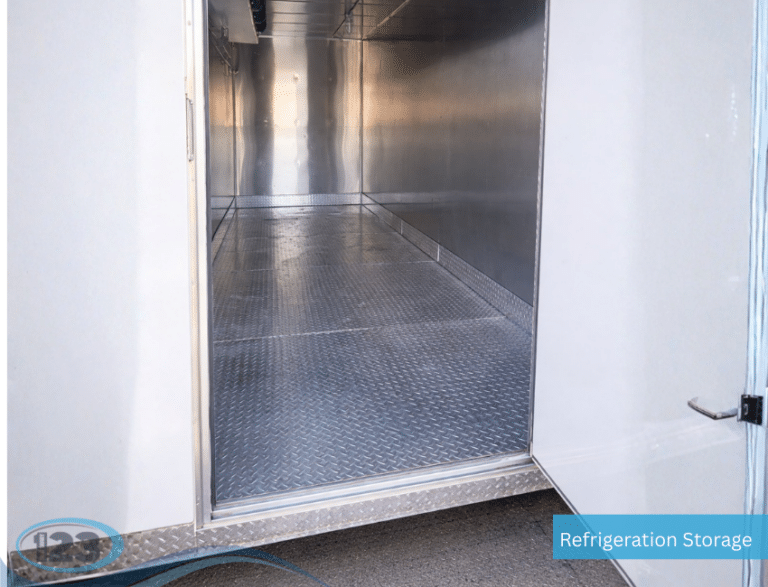
A cold-storage audit requires clean, durable, and maintainable surfaces rather than a unit with visible residue, pooled liquid, damaged shelving, or contaminated door hardware. IcefoxEquipment describes stainless-steel interiors as corrosion-resistant and easy to clean, while its 5-day sanitation guidance emphasizes daily cleaning.
A daily program should cover at least 7 areas:
- Interior walls and accessible ceiling surfaces.
- Floor and floor-to-wall transitions.
- Shelving and storage racks.
- Door, handle, gasket, and threshold.
- Condensation or drip areas.
- Spill and leakage locations.
- Waste, packaging, and damaged-product areas.
Use only cleaning and sanitizing chemicals approved for the surface and application. Follow the chemical label for concentration, preparation, contact time, rinsing, ventilation, and employee protection.
Our practical view is that a wet floor is not proof of cleaning. A floor still containing pooled water after 1 washdown may indicate poor drainage, excessive chemical use, or an incomplete drying process that creates another audit concern.
How Should Food Be Organized for Inspection?
Food should be covered, labeled, elevated, separated by risk, and arranged so cold air can circulate. IcefoxEquipment’s 5-day sanitation guidance specifically emphasizes food separation and airflow management as part of compliant temporary storage.
Storage clearance and shelving requirements may vary by local code and facility policy. Apply the approved clearance around floors, walls, ceilings, evaporators, and return-air paths throughout the rental period.
At minimum, use 3 organizational zones: ready-to-eat products, raw products, and nonfood or packaging materials. Raw foods should be arranged to prevent leakage onto ready-to-eat inventory according to the facility’s approved storage hierarchy.
Do not pack cartons tightly against the evaporator or block a return-air path. A trailer may display 38°F near the controller while a tightly packed corner remains warmer because air cannot move through the load.
How Does IcefoxEquipment Support Audit Preparation?
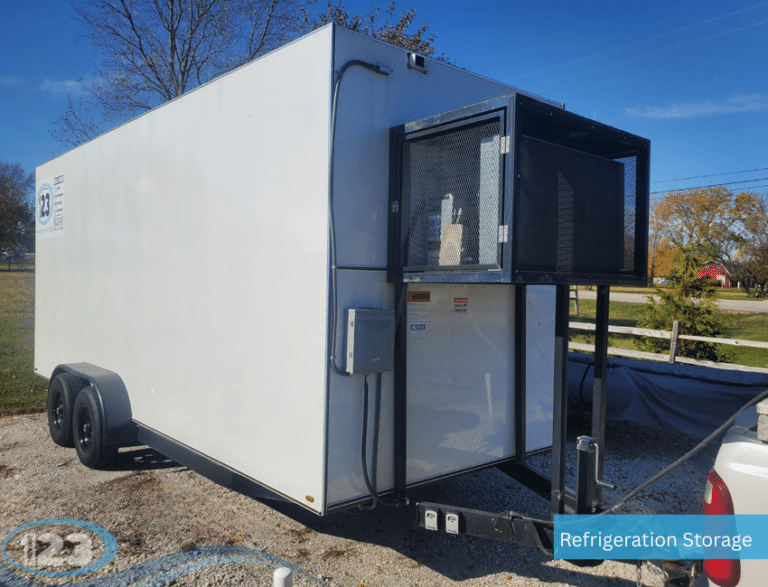
IcefoxEquipment supports audit preparation through temporary refrigeration equipment, stainless-steel interiors, multiple unit sizes, and 24/7 operational assistance. Common renovation configurations include approximately 8-foot, 16-foot, and 20-foot units, depending on required capacity and site conditions.
Before delivery, provide the operating temperature, product type, expected inventory, rental duration, available power, unloading method, and inspection date. The IcefoxEquipment sanitation compliance resource explains the role of monitoring, cleaning, separation, and airflow during a 5-day rental.
The customer walkthrough material makes the operator responsible for confirming that refrigeration meets the required temperature standard. A walkthrough may be provided within a 10-hour no-charge window after delivery, but the customer must still verify actual performance before loading regulated inventory.
By the Numbers
| Audit or setup item | Source-supported figure |
|---|---|
| Refrigerated holding target | 41°F or below |
| Frozen holding target | 0°F or below |
| Published equipment range | -20°F to 70°F |
| Typical electrical supply | 220V, single phase |
| Setup amperage | 40–60 amps |
| Preferred amperage during repeated trips | 50–60 amps |
| Customer-supplied cord | 50 ft, 6 AWG |
| Common unit sizes | 8 ft, 16 ft, 20 ft |
| Example sanitation period | 5 days |
| Operational assistance | 24/7 |
The table provides 10 planning figures, but it does not replace the unit data plate or local health-department requirements. Confirm the inspection standard that applies to the project’s city, county, state, food type, and permit classification.
What Is the Step-by-Step Audit Preparation Process?
Use this 8-step preparation process before the inspector arrives:
- Confirm the required refrigerated and frozen limits.
- Review every temperature entry for missing times or unexplained deviations.
- Test the thermometer or monitoring device according to the approved procedure.
- Inspect power, breaker, cord, plug, and controller.
- Clean the unit and document the completed sanitation work.
- Organize food into protected, separated storage zones.
- Review corrective-action and emergency-transfer procedures with staff.
- Conduct a final walkthrough and photograph the ready condition.
Complete the review before the final 1-hour period preceding inspection. Last-minute cleaning or product movement can introduce open doors, warm air, missing labels, and disorganized records at the worst possible time.
What Common Cold-Storage Audit Mistakes Should You Avoid?
Mistake 1: Recording Only One Daily Temperature
A single 41°F reading does not show what happened during deliveries, loading, overnight storage, or peak door activity. Use the monitoring frequency approved by your health authority and facility food-safety plan.
Mistake 2: Ignoring Power Trips
A 40-amp breaker that trips repeatedly can create undocumented temperature loss. Confirm whether the unit requires up to 60 amps and have a qualified electrician correct the supply.
Mistake 3: Blocking Airflow
A fully packed 20-foot trailer can still fail to cool evenly when cartons obstruct the evaporator or return-air path. Maintain the clearances specified by the equipment instructions and approved facility plan.
Mistake 4: Keeping Perfect Logs Without Corrective Actions
A log containing 0 corrective actions during repeated operational problems may appear unreliable. Record real events, including the response and final result.
Mistake 5: Treating the Rental Company as the Permit Holder
IcefoxEquipment provides equipment and 24/7 support, but the food operator remains responsible for permits, procedures, food handling, and local inspection compliance.
Cold-Storage Audit Decision Checklist
- ☐ Confirm refrigerated food is maintained at 41°F or below.
- ☐ Confirm frozen food is maintained at 0°F or below.
- ☐ Verify the unit’s 220V electrical connection.
- ☐ Confirm the required 40–60-amp service.
- ☐ Inspect the 50-foot, 6 AWG cable when customer-supplied.
- ☐ Review temperature logs for every required monitoring period.
- ☐ Document daily cleaning throughout the 5-day or longer deployment.
- ☐ Verify food separation, labels, covers, and airflow.
- ☐ Keep the 24/7 service number available for equipment support.
- ☐ Confirm the local inspection schedule and advance-booking requirements.
Request a Quote
Request a quote today for industry-leading refrigeration, modular facilities, and mobile equipment solutions. Ice Fox Equipment provides rapid deployment, flexible rental and leasing options, and dependable support for construction, healthcare, food service, emergency response, and industrial operations. Contact our team now for a customized, no-obligation quote.
Frequently Asked Questions
IcefoxEquipment’s published guidance states that refrigerated food should generally remain at 41°F or below, while frozen products should generally stay at 0°F or below. IcefoxEquipment recommends documented monitoring and corrective action, but the local authority may impose additional limits, forms, or monitoring intervals.
IcefoxEquipment states that modern refrigeration equipment may include tracking, real-time temperature monitoring, and alerts across a range of approximately -20°F to 70°F. Confirm the exact monitoring package on the quoted unit because features vary by configuration, application, and rental agreement.
A common IcefoxEquipment refrigerated-trailer setup requires 220V, single-phase power at 40–60 amps. The uploaded setup material recommends 50–60 amps when breakers repeatedly trip. Final power must be verified against the specific unit’s data plate and connected by a qualified commercial electrician.