
How Independent Film Productions Feed Remote Crews with Mobile Kitchen Pods | IceFoxEquipment
Article Plans
Last updated: August 12, 2026
Independent film productions shooting far from established catering facilities still have to feed cast and crew on schedule. IceFoxEquipment supports remote film operations with mobile kitchens, refrigeration, dishwashing, living facilities, potable water, power, and production trailers, while kitchen capacities range from 50–200 meals/day in a 24-ft unit to 1,500–3,000 meals/day in a 40-ft bulk kitchen. Production teams can review IceFoxEquipment before locking the location-support plan.
Quick Answer
Independent films can feed remote crews by placing commercial mobile kitchen pods or trailers directly at the production basecamp. A 24-ft kitchen can support 50–200 meals/day, while a 40-ft bulk kitchen can support 1,500–3,000 meals/day. Refrigeration, dishwashing, potable water, power, sleepers, and production facilities can be deployed alongside the kitchen.
Quick Facts
- A 24-ft mobile kitchen supports 50–200 meals/day and rents for $4,995–$7,995.
- A 28-ft mobile kitchen supports 300–500 meals/day and rents for $5,995–$8,995.
- A 40-ft bulk kitchen supports 1,500–3,000 meals/day and rents for $9,995–$14,995.
- A 20-ft refrigerated trailer operates at a listed 34°F–41°F and rents for $1,495–$2,395.
- IceFoxEquipment explicitly markets remote catering for film crews and production trailers for on-location film/TV work.
- IceFoxEquipment advertises 24/7 support at 800-245-5216.
Why Do Remote Film Productions Use Mobile Kitchen Pods?
A remote set may be too far from a restaurant kitchen, commissary, or permanent production facility to support every meal call efficiently. IceFoxEquipment’s current Remote Catering page specifically lists remote catering for film crews, while its Production Trailer page describes highly mobile film and TV facilities built around on-location work.
Bringing a 24-ft, 28-ft, or 40-ft kitchen to the location moves food production closer to where the crew is actually working. That can be particularly useful when the production schedule changes during a 1-day shoot or moves between isolated exterior locations where off-site meal preparation adds another logistics leg.
We generally prefer sizing around the actual number of meals rather than the number of people on the call sheet. A crew of 100 people receiving multiple meal periods and catering support can create a different production load from a crew of the same size receiving only one simple meal, so menu complexity and daily meal count belong in the same sizing conversation.
What Size Mobile Kitchen Does an Independent Film Need?
For smaller productions, the 24-ft kitchen supports 50–200 meals/day at a listed rental range of $4,995–$7,995. It is a practical starting point when the crew is modest, the menu is controlled, and the production does not require high-volume bulk cooking.
A 28-ft kitchen supports 300–500 meals/day for $5,995–$8,995, while the 38-ft kitchen supports 500–1,000 meals/day for $7,995–$10,995. These middle sizes provide a useful bridge when an independent production has outgrown a 24-ft setup but does not need institutional-scale bulk output.
At the high end, a 40-ft bulk kitchen supports 1,500–3,000 meals/day and is listed at $9,995–$14,995. The source material describes bulk kitchens with equipment such as 2–3 double-stack convection ovens, tilt kettles, and tilt skillets, which favor large-batch production rather than an elaborate made-to-order menu.
Mobile Kitchen Options by Crew Feeding Volume
| Mobile kitchen | Published meal capacity | Planning rental |
|---|---|---|
| 24-ft kitchen | 50–200/day | $4,995–$7,995 |
| 26-ft Baby Bulk | 200–600/day | $7,995–$10,995 |
| 28-ft kitchen | 300–500/day | $5,995–$8,995 |
| 38-ft kitchen | 500–1,000/day | $7,995–$10,995 |
| 40-ft kitchen | 500–1,500/day | $8,995–$12,995 |
| 40-ft bulk kitchen | 1,500–3,000/day | $9,995–$14,995 |
These 6 kitchen configurations show why “we have a remote film crew” is not enough information for sizing. Production should provide expected meals per day, menu style, schedule, refrigeration needs, available utilities, and the number of service periods before the kitchen is selected.
How Does Refrigeration Fit into Location Catering?
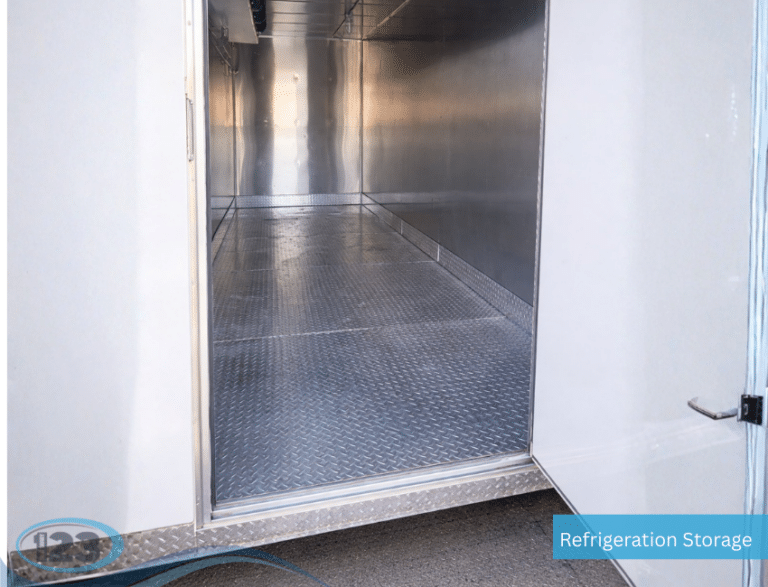
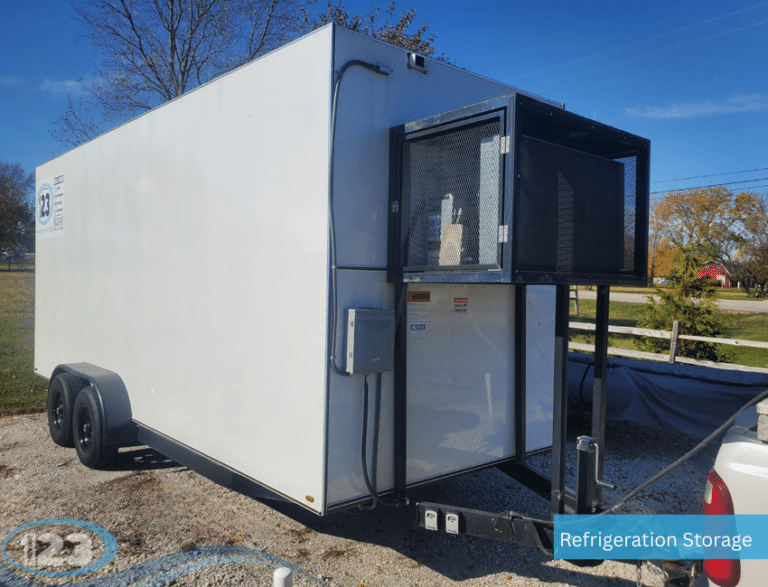
Remote catering needs cold storage separate from the cooking line when ingredient volume exceeds the reach-in refrigeration inside the kitchen. The newer fleet guide lists a 12-ft refrigerated trailer at $1,295–$2,195 and a 20-ft refrigerated trailer at $1,495–$2,395, both in the documented 34°F–41°F refrigerated category.
For frozen inventory, the separate 20-ft freezer trailer is listed at 0°F to -10°F and $1,495–$2,395. A film caterer carrying refrigerated proteins, produce, prepared items, frozen inventory, and beverages should specify which of those 2 temperature categories the location actually requires rather than simply requesting “a reefer.”
When Does a Film Crew Need a Dishwashing Trailer?
Reusable plates, trays, pans, and catering equipment can turn warewashing into its own production bottleneck. The current internal guide lists 22–26-ft low-temp units at 1,200–1,500 dishes/hour, a 30-ft conveyor at 2,000 dishes/hour, and a 38-ft conveyor at 2,500–3,000 dishes/hour.
A small production using disposables may not need a dedicated 22-ft dish trailer, which is why we would not automatically bundle one into every shoot. But when the catering plan uses reusable service ware or a high volume of cookware, placing warewashing beside the kitchen can keep the 50–3,000 meal/day cooking operation from losing prep space to cleanup.
By the Numbers
| Film-production support item | Figure |
| Small kitchen output | 50–200 meals/day |
| Bulk kitchen output | 1,500–3,000 meals/day |
| Refrigerated trailer range | 34°F–41°F |
| Freezer trailer range | 0°F to -10°F |
| Low-temp warewashing | 1,200–1,500 dishes/hour |
| Large conveyor warewashing | 2,500–3,000 dishes/hour |
| Small kitchen footprint | 24 × 15 ft minimum |
| Delivery turning radius | 60 ft minimum |
These 8 figures are useful during location scouting because the catering department has to compete for space with trucks, grip equipment, electrical distribution, wardrobe, talent vehicles, and production offices. A mobile kitchen is operational infrastructure, so the 24 × 15-ft footprint should be reserved before the shooting company fills the basecamp.
How Can a Production Combine Food Service with Crew Support?
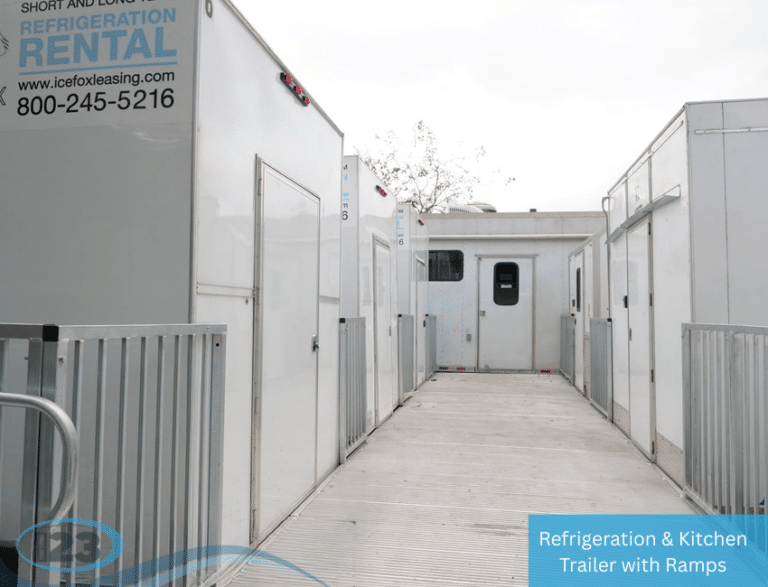
IceFoxEquipment’s current Production Trailer page describes on-location units that can include a full kitchen, living area, and 2 exterior restroom/shower spaces, plus dedicated wardrobe, hair, and makeup areas. That makes combination equipment relevant to smaller independent shoots where reducing the number of separate trailers can simplify the support compound.
The uploaded project documents also list kitchen-sleeper, kitchen-office, production-center/office, shower/restroom, refrigeration, laundry, and 20-ft sleeper configurations for film-production support. A 38-ft shower/restroom + 3-bedroom sleeper is currently listed at $3,995–$6,995, while individual 20-ft sleeper containers are $2,195–$2,995.
For larger remote shoots, IceFoxEquipment’s remote catering for film crews page also groups kitchens with refrigeration, dishwashing, potable water, laundry, living quarters, offices, and generator support. The page advertises basecamp/event services starting from $1,495, although that figure should not be interpreted as the price of a complete film catering compound.
How Do You Plan a Remote Film Catering Setup?
Use this 7-step process before the unit trucks arrive.
- Count meals, not just crew. Select a kitchen from 50–200 meals/day through 1,500–3,000 meals/day based on total daily production.
- Simplify or expand the menu deliberately. Bulk equipment with 2–3 double-stack convection ovens, tilt skillets, and kettles supports high-volume production, while scratch cooking generally requires more prep space.
- Add cold storage. Choose a 34°F–41°F refrigerator or separate 0°F to -10°F freezer configuration.
- Decide on service ware. If reusable service creates high volume, size warewashing from 1,200 to 3,000 dishes/hour.
- Reserve the physical footprint. A 24-ft kitchen needs at least 24 × 15 ft, while a 40-ft kitchen needs about 40 × 20 ft minimum.
- Protect truck access. The master fleet guide calls for a 12-ft gate, 14-ft vertical clearance, and 60-ft turning radius.
- Keep operations support available. IceFoxEquipment advertises 24/7 support at 800-245-5216 and says quotes may be available in about 1 hour.
What Common Film Catering Mistakes Should You Avoid?
Mistake 1: Booking by Crew Headcount Alone
A 100-person crew does not automatically need the same kitchen on every production because menu complexity and number of daily meal services change total output. Use the published 50–3,000 meals/day capacity ranges as the first sizing screen.
Mistake 2: Forgetting Refrigerated Overflow
A 24-ft kitchen can cook for 50–200 meals/day, but production still has to store ingredients safely before cooking. A separate 20-ft refrigerator at 34°F–41°F can keep bulk cold storage from consuming working room inside the cooking trailer.
Mistake 3: Putting Catering Wherever Space Is Left
A 40-ft kitchen needs approximately 40 × 20 ft minimum, and delivery planning calls for a 60-ft turning radius. Reserving catering space after camera, grip, wardrobe, generators, and talent trailers have already parked can make a workable production basecamp difficult to install.
Mistake 4: Overcomplicating the Menu on a Remote Set
The source materials show that a 40-ft bulk kitchen with 2–3 double-stack convection ovens, tilt skillet, and tilt kettle is designed around batch efficiency. For a remote crew, a disciplined menu can make better use of that equipment than trying to reproduce a highly varied restaurant menu in the field.
Film Production Catering Decision Checklist
- Confirm daily production against the 50–3,000 meals/day kitchen range.
- Decide whether a 24-, 26-, 28-, 38-, or 40-ft kitchen fits the menu and crew load.
- Add 34°F–41°F refrigerated storage where the kitchen’s internal cold space is insufficient.
- Add the 0°F to -10°F freezer configuration when frozen inventory is required.
- Decide whether service ware requires 1,200–3,000 dishes/hour of dedicated warewashing.
- Reserve at least 24 × 15 ft for the smallest documented kitchen footprint.
- Maintain a 12-ft gate, 14-ft clearance, and 60-ft turning radius for delivery planning.
- Keep IceFoxEquipment’s 24/7 support line, 800-245-5216, with the production coordinator.
Key Takeaways
- Match crew feeding volume to a kitchen ranging from 50–200 meals/day to 1,500–3,000 meals/day instead of choosing a trailer by length alone.
- Add refrigeration early because a 20-ft refrigerated trailer at 34°F–41°F gives the catering team separate cold-storage capacity beside the kitchen.
- Reusable dish service can require dedicated warewashing, with available systems ranging from 1,200–1,500 dishes/hour to 2,500–3,000 dishes/hour.
- Remote production support can extend beyond catering because IceFox’s film-production units may combine a kitchen with living space and 2 exterior shower/restrooms.
Request a Quote
Request a quote today for industry-leading refrigeration, modular facilities, and mobile equipment solutions. Ice Fox Equipment provides rapid deployment, flexible rental and leasing options, and dependable support for construction, healthcare, food service, emergency response, and industrial operations. Contact our team now for a customized, no-obligation quote.

Frequently Asked Questions
Yes. IceFoxEquipment’s current Remote Catering page specifically lists remote catering for film crews, and its production-trailer page describes on-location film/TV facilities. Kitchen capacity ranges from 50–200 meals/day for a 24-ft kitchen to 1,500–3,000 meals/day for a 40-ft bulk configuration.
IceFoxEquipment-related fleet data lists a 24-ft kitchen at 50–200 meals/day, a 28-ft unit at 300–500, a 38-ft model at 500–1,000, and a 40-ft bulk kitchen at 1,500–3,000 meals/day. Choose by total daily meals, menu complexity, prep requirements, and available site utilities.
Current internal planning rates range from $4,995–$7,995 for the 24-ft kitchen to $9,995–$14,995 for a 40-ft bulk kitchen. IceFoxEquipment’s production page separately advertises production-trailer leasing/rental starting from $1,295, but that starting figure should not be represented as the price of a full commercial kitchen package.