
How Do Disaster Basecamps Keep Rations Frozen? IcefoxEquipment Field Guide
Article Plans
Disaster basecamps keep rations frozen by combining mobile walk-in freezers, 0°F to -10°F operating temperatures, continuous electrical service, controlled loading procedures, and backup refrigeration capacity. IcefoxEquipment supplies mobile freezers, refrigeration trailers, generators, kitchens, and other basecamp infrastructure for emergency operations across the United States.
A reliable frozen-food plan must protect more than the freezer itself. It must account for 24-hour power, delivery access, product rotation, door openings, generator fuel, defrosting, temperature records, and a replacement plan if the primary unit fails.
Quick Answer: Disaster basecamps commonly keep rations frozen in mobile freezer trailers operating from 0°F to -10°F, with selected IcefoxEquipment units capable of settings as low as -20°F. A standard 20-foot freezer trailer requires reliable single-phase power, and a 25–30 kW generator may be used where utility service is unavailable.
Quick Facts
- A standard 20-foot freezer trailer has a documented rental range of $1,495–$2,395.
- The standard documented freezer temperature range is 0°F to -10°F.
- IcefoxEquipment publishes available settings of 35°F, 0°F, -10°F, and -20°F.
- Uploaded setup guidance calls for 220V, single-phase, 40–60-amp service.
- A 25–30 kW generator is recommended for a standard freezer-trailer load.
- IcefoxEquipment advertises 24/7 operational support and emergency deployment.
Key Takeaways
- Frozen rations should be assigned to a dedicated unit operating at 0°F, -10°F, or -20°F, rather than sharing space with refrigerated food held near 35°F.
- A 20-foot freezer trailer needs verified power before delivery, with uploaded guidance calling for 40–60 amps.
- A basecamp serving 25 to more than 500 personnel needs storage sized around delivery frequency, menu volume, and reserve inventory.
- A 12-foot gate, 14 feet of vertical clearance, and approximately 60 feet of turning space can determine whether the freezer can reach the planned staging area.
- Projects lasting 6, 12, or 24 months should request long-term pricing and a documented service plan.
What Equipment Keeps Disaster Rations Frozen?
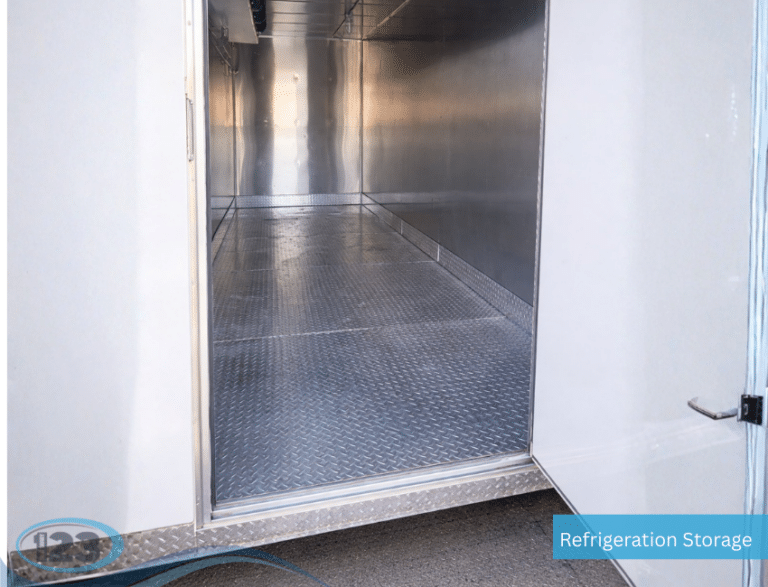
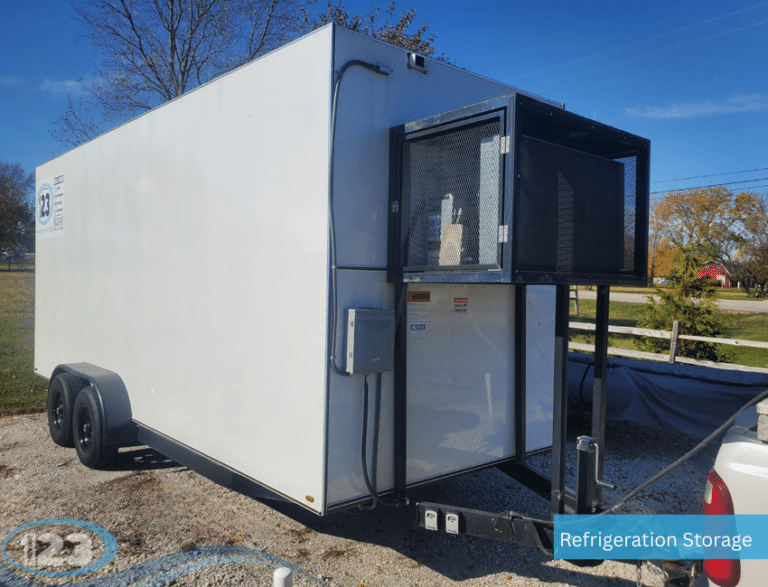
A disaster basecamp generally uses a mobile walk-in freezer, freezer trailer, refrigerated container, or several units divided by product category. IcefoxEquipment lists 7 × 12, 7 × 20, 7 × 26, 8 × 20, and 8 × 40-foot configurations for temporary cold-storage operations.
A 20-foot freezer trailer is approximately 20 feet long, 7 feet wide, and 8 feet high, with an approximate weight of 5,000 pounds. That size can support organized pallet, rack, cart, and case storage without requiring the permanent construction of a freezer room.
Larger emergency operations may use a 40-foot refrigerated container, which has a documented planning rate of $2,995–$3,995. Smaller operations may use a 12-foot refrigerated trailer priced at $1,295–$2,195, although refrigerated space should not replace true freezer capacity when rations must remain at or below 0°F.
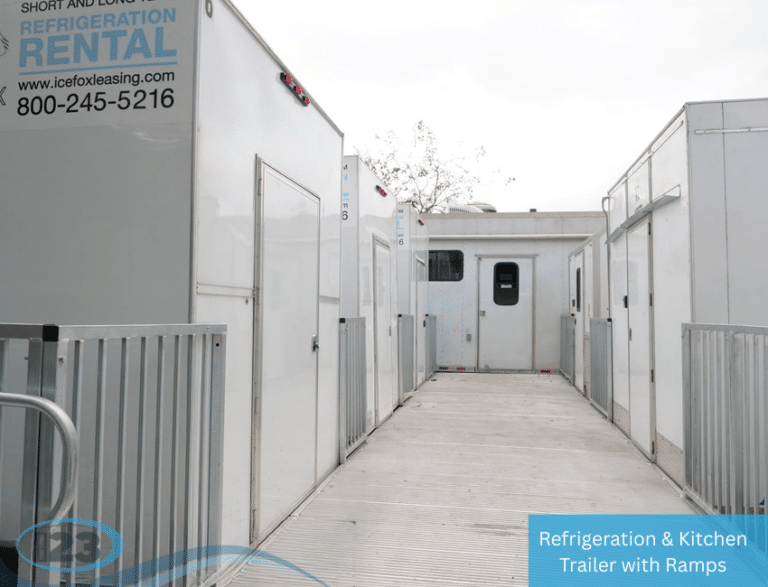
IcefoxEquipment’s basecamp service model combines refrigeration with modular kitchens, dining facilities, generators, potable water, wastewater systems, sleeper units, showers, restrooms, and support infrastructure. A complete basecamp therefore treats frozen storage as 1 connected part of the food-service system rather than as an isolated trailer.
How Cold Must the Freezer Stay?
Frozen rations are commonly assigned to equipment operating at 0°F to -10°F, while selected IcefoxEquipment units can be configured to -20°F. The written rental agreement should state the required setting because 35°F refrigeration and 0°F frozen storage serve different purposes.
A unit set to 0°F still needs operating headroom because every door opening allows warm, humid air to enter. The website notes a 5-degree difference associated with opening and closing some cold-storage units, which reinforces the need to limit unnecessary access.
In our experience, the simplest field rule is also the most effective: assign 1 person or team to control freezer access during each meal-production shift. An open-door free-for-all creates frost, slows recovery, and makes it harder to identify which case entered or left the unit.
The second practical rule is to separate 3 basic workflows: receiving, reserve storage, and daily issue. Crews should not dig through long-term reserve inventory every time the kitchen needs a case of protein.
By the Numbers: Basecamp Freezer Planning
| Planning factor | Source-grounded figure |
|---|---|
| Standard freezer trailer | 20 feet |
| Standard freezer temperature | 0°F to -10°F |
| Lowest published setting | -20°F |
| Documented freezer rental | $1,495–$2,395 |
| Uploaded electrical requirement | 220V, 40–60 amps |
| Recommended generator | 25–30 kW |
| Emergency delivery statement | Within 12 hours in many cases |
| Operational support | 24/7 |
| Gate clearance | 12 feet |
| Vertical clearance | 14 feet |
These 10 figures should appear in the site plan, electrical scope, procurement file, or deployment checklist. Guessing about any 1 of them can delay commissioning or leave frozen inventory without dependable capacity.
How Does IcefoxEquipment Plan Freezer Capacity for a Basecamp?
IcefoxEquipment can match storage capacity to workforce size, meal frequency, resupply intervals, menu mix, and deployment duration. Published basecamp material discusses temporary operations supporting 25 to more than 500 personnel, so a freezer plan must reflect the actual feeding mission rather than a generic headcount.
How Many Days of Food Will Be Stored?
A 5-day food reserve requires a different layout from a basecamp receiving frozen deliveries every day. Longer resupply intervals increase the need for reserve space, clear labeling, and separation between incoming cases and ready-to-issue stock.
What Type of Rations Are Being Stored?
A menu built around 3 frozen protein items may use space differently from a menu containing boxed entrées, frozen vegetables, bread, desserts, and ice. Case dimensions and stacking restrictions matter as much as total weight.
How Often Will the Door Open?
A freezer accessed 20 times during a production period faces a different heat and moisture load from a reserve unit opened only twice. We recommend using a smaller issue zone near the door and placing slower-moving reserves toward the rear.
Is One Freezer Enough?
A single 20-foot freezer may be adequate for a smaller basecamp, but larger operations can reduce risk by dividing inventory between 2 units. Losing half the available capacity is easier to manage than exposing the entire frozen-food reserve to one mechanical or electrical failure.
What Power Setup Keeps the Freezer Running?
The uploaded installation guide calls for 220V, single-phase, 40–60-amp service, with 50–60 amps preferred when breakers are prone to tripping. The individual freezer’s data plate must still govern the final connection because IcefoxEquipment also publishes 208–230V, single-phase, 30-amp service for selected 7 × 12 and 7 × 20 units.
A licensed electrician should verify voltage, phase, breaker size, receptacle or disconnect type, grounding, cable length, and conductor size before the freezer arrives. For cable runs up to 50 feet, the uploaded power guide specifies 6 AWG copper.
Where utility power is unavailable, a 25–30 kW generator may support a standard freezer trailer. The uploaded electrical guide also recommends sizing generation and distribution capacity 20%–25% above the calculated load to accommodate compressor startup and cycling.
A generator operating 24 hours a day also needs fuel scheduling, maintenance access, weather protection, and a refueling procedure that does not require an extended shutdown. A generator without fuel logistics is not a backup system; it is a temporary delay.
The basecamp should document 2 power paths whenever frozen inventory is mission-critical: the normal supply and the alternate supply. The alternate may be a second generator, a spare distribution panel, or a preplanned transfer to another refrigeration unit.
How Should the Freezer Be Positioned at the Basecamp?
The freezer should be placed on stable, level ground near the kitchen but outside high-traffic pedestrian and vehicle routes. Uploaded delivery guidance calls for a 12-foot gate, at least 14 feet of vertical clearance, and an approximate 60-foot turning radius.
Concrete, asphalt, or compacted gravel is preferable to mud, loose sand, or saturated turf. A 5,000-pound freezer trailer can settle or shift on weak ground, particularly when loaded and exposed to repeated rain or vehicle traffic.
The trailer door may sit 24–36 inches above grade, so stairs, platforms, handrails, or ramps may be required. Safe access must be planned before crews begin moving heavy cases during a 12-hour shift.
Shade can also help in high heat. The uploaded setup document warns that direct summer sun can make low-temperature holding more difficult, increase frost or ice accumulation, and contribute to breaker trips when the available circuit is below 60 amps.
We advise against placing the freezer directly beside a generator exhaust outlet. Even with 25–30 kW of available power, hot exhaust, vibration, fumes, and restricted maintenance access can create unnecessary operational problems.
How Do Crews Protect Frozen Rations During Daily Operations?
Crews protect frozen rations through controlled receiving, clear labeling, limited door openings, temperature checks, product rotation, and rapid response to electrical or refrigeration alarms. A 24-hour basecamp needs written shift handoffs because the freezer cannot depend on one person’s memory.
Use at least 3 visible zones inside the unit: incoming product, active issue stock, and reserve stock. This prevents newly delivered cases from blocking food needed for the next meal period.
Record the freezer temperature at scheduled intervals and after major events such as delivery, generator transfer, prolonged door opening, or breaker reset. A unit set at -10°F may temporarily rise during loading, but the crew needs a written record showing when the rise occurred and when the unit recovered.
Keep cartons off evaporator airflow paths and leave clearance around refrigeration components. Filling every inch of a 20-foot trailer may look efficient, but blocked airflow can create uneven temperatures and slow recovery.
Our strongest operational opinion is that most basecamps do not need a larger freezer first; they need better organization first. Clear aisle space and a 1-page inventory map can recover usable capacity without adding another trailer.
Step-by-Step: How to Set Up Frozen-Ration Storage
Use this 7-step process before the first frozen delivery arrives.
- Calculate the reserve period. Document whether the basecamp will hold 1, 3, 5, or more days of frozen food.
- Select the freezer size. Compare 7 × 12, 7 × 20, 7 × 26, 8 × 20, and 8 × 40-foot options.
- Choose the temperature. State 0°F, -10°F, or -20°F in the equipment request.
- Verify the electrical source. Confirm the required 208–230V or 220V service and the correct amperage.
- Plan backup power. Reserve a 25–30 kW generator or another approved source when utility service is uncertain.
- Prepare access. Verify the 12-foot gate, 14-foot height clearance, and 60-foot maneuvering area.
- Test before loading. Operate the unit long enough to confirm the selected setpoint before transferring 1 case of frozen inventory.
The mobile-freezer details on IcefoxEquipment’s refrigeration page can help you identify a suitable configuration before calling 800-245-5216. IcefoxEquipment presents these units for emergency storage, food service, healthcare preservation, and large-scale industrial applications.
What Common Mistakes Put Frozen Rations at Risk?
Mistake 1: Treating a Cooler as a Freezer
A unit operating at 35°F cannot replace equipment required to hold rations at 0°F, -10°F, or -20°F. Confirm the temperature in writing rather than relying on the general phrase “cold storage.”
Mistake 2: Connecting to an Undersized Circuit
A 30-amp connection may serve selected standard models, while another 20-foot trailer may require 40–60 amps. The data plate and rental documentation must control the installation.
Mistake 3: Operating Without a Backup Plan
A basecamp storing 5 days of food should not depend on one generator, one cable, and one freezer without an emergency transfer procedure. A second unit or transfer location may be justified for critical inventory.
Mistake 4: Loading Before the Setpoint Is Verified
A freezer should reach 0°F, -10°F, or the contracted setting before rations are loaded. Using frozen product to cool a warm box wastes product temperature and extends recovery time.
Mistake 5: Blocking Airflow
A 20-foot trailer packed from wall to wall can develop warm pockets when cartons obstruct evaporator airflow. Preserve an aisle and the equipment clearances specified for the delivered unit.
Disaster Basecamp Freezer Decision Checklist
- ☐ Confirm whether rations require 0°F, -10°F, or -20°F storage.
- ☐ Match inventory volume to a 12-, 20-, or 40-foot configuration.
- ☐ Verify the written rate, including the $1,495–$2,395 20-foot planning range.
- ☐ Confirm the required 208–230V or 220V electrical service.
- ☐ Verify whether the delivered model needs 30 amps or 40–60 amps.
- ☐ Reserve a 25–30 kW generator when utility power is uncertain.
- ☐ Maintain a 20%–25% electrical capacity margin where applicable.
- ☐ Confirm the 12-foot gate, 14-foot clearance, and 60-foot turning area.
- ☐ Plan safe access for a floor approximately 24–36 inches above grade.
- ☐ Establish 24-hour temperature checks and shift handoffs.
- ☐ Identify at least 1 backup transfer location or replacement plan.
- ☐ Call 800-245-5216 with the ZIP code, dates, headcount, and freezer setting.
Request a Quote
Request a quote today for industry-leading refrigeration, modular facilities, and mobile equipment solutions. Ice Fox Equipment provides rapid deployment, flexible rental and leasing options, and dependable support for construction, healthcare, food service, emergency response, and industrial operations. Contact our team now for a customized, no-obligation quote.

Frequently Asked Questions
IcefoxEquipment publishes settings of 35°F, 0°F, -10°F, and -20°F, while the uploaded standard freezer-trailer range is 0°F to -10°F. Frozen-ration storage should normally use a true freezer setting, with the exact temperature documented in the rental order and verified before inventory is loaded.
The correct size depends on workforce headcount, menu, reserve days, delivery schedule, and package dimensions. IcefoxEquipment lists 7 × 12 through 8 × 40-foot options, and published basecamp examples range from 25 to more than 500 personnel. A site-specific inventory calculation should determine the final selection.
Yes. IcefoxEquipment states that walk-in cold storage may be delivered within 12 hours in many emergency cases, subject to inventory, distance, access, power, and site readiness. The company also publishes 24/7 emergency support for mobile refrigeration and basecamp operations across the United States.