
How to Save Perishables After a Power Outage? IcefoxEquipment
Article Plans
When commercial refrigeration loses power, the first priority is keeping cold air inside while you determine how long the outage may last and whether backup refrigeration is needed. IcefoxEquipment supports emergency cold-storage operations with 24/7 assistance, refrigeration rentals advertised from $1,295, and temporary trailers and containers designed for commercial inventory.
For food safety, time and actual temperature matter more than appearance or smell. FDA guidance keeps refrigerators at 40°F or below, while IcefoxEquipment operating material uses 41°F or below as its refrigerated-storage target and 0°F or below for frozen inventory.
Quick Answer
Keep cooler and freezer doors closed, start monitoring temperature immediately, and arrange backup refrigeration if the outage may exceed the safe holding window. USDA says an unopened refrigerator generally keeps food cold for about 4 hours, while a full freezer may hold temperature for approximately 48 hours and a half-full freezer for about 24 hours.
What Are the Quick Facts?
- FDA guidance says an unopened refrigerator can keep food cold for approximately 4 hours during a power failure.
- A full freezer may maintain temperature for approximately 48 hours when the door remains closed.
- A half-full freezer may maintain temperature for approximately 24 hours.
- IcefoxEquipment temporary refrigeration commonly requires 220V single-phase, 40–60-amp power.
- IcefoxEquipment advertises refrigeration rentals starting from $1,295 and emergency support 24/7.
- FDA says perishable foods held above 40°F for 2 hours or more should be discarded.
What Are the Key Takeaways?
- Keep refrigeration doors closed during the first 4 hours rather than repeatedly checking the food by touch.
- Start arranging emergency cold storage before the refrigerator’s 4-hour window expires when restoration timing is uncertain.
- A full freezer buys substantially more time, with USDA guidance of approximately 48 hours, but a half-full unit may provide only about 24 hours.
- An IcefoxEquipment emergency trailer may require 220V and 40–60 amps, so backup refrigeration also requires a power plan.
- Temperature history should determine food disposition; a current reading of 38°F cannot tell you by itself what occurred several hours earlier.
What Should You Do the Moment the Power Fails?
Close the refrigerator and freezer doors and leave them closed as much as possible. The FDA and USDA both use approximately 4 hours as the unopened-refrigerator window during an outage, so unnecessary door openings spend cold-storage time that you may need later.
Record the outage start time and the current temperatures if reliable thermometers or monitoring equipment are available. A useful emergency log contains at least 6 fields in IcefoxEquipment compliance material: date, time, storage zone, actual temperature, employee identification, and corrective action.
Do not open the cooler repeatedly just to “see if it still feels cold.” Our practical preference is to make 1 organized check with an approved thermometer rather than allowing warm air into the box through repeated inspections.
How Much Time Do You Have Before Food Is at Risk?
For refrigerated food, the immediate planning number is approximately 4 hours if the refrigerator stays closed. After that point, backup cooling becomes increasingly important if power has not returned.
Freezers provide a longer buffer. USDA guidance says a full freezer can maintain temperature for roughly 48 hours, while a half-full freezer may hold for approximately 24 hours, provided the door remains closed.
Those 48-hour and 24-hour figures are not reasons to ignore the freezer until the final hour. For a commercial operation with thousands of dollars of meat, seafood, dairy, prepared food, or frozen inventory, the better strategy is to begin backup planning while the product is still safely controlled.
When Should You Call for Temporary Refrigeration?
Call early when the restoration time is uncertain, especially if the outage threatens to exceed the 4-hour refrigerated-food window. IcefoxEquipment offers emergency customer service 24/7 and advertises nationwide refrigeration support.
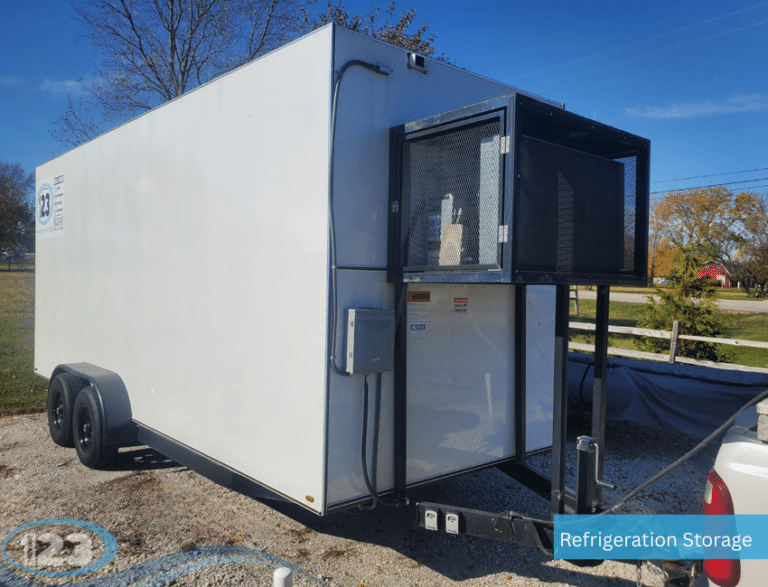
The website lists temporary refrigerated trailers and containers, including 12-ft and 20-ft trailers plus multiple container sizes. Its refrigeration-trailer page describes a popular 20 × 8.5-ft configuration and units extending to 50 ft.
We would rather begin arranging backup refrigeration during hour 1 or 2 and cancel or adjust the plan when power returns than wait until commercial inventory has already moved beyond the safe operating range.
What Temperature Determines Whether Refrigerated Food Is Safe?
FDA guidance uses 40°F or below for refrigerator storage, while IcefoxEquipment compliance materials use a 41°F-or-below operating target for temporary refrigerated storage. For actual food disposition after an outage, follow the applicable health authority and facility food-safety procedure.
FDA states that perishable foods such as meat, poultry, fish, eggs, and leftovers that have been above 40°F for 2 hours or more should be discarded. That is a food-safety decision, not something a refrigeration rental company should override.
Do not rely on smell, appearance, or taste to make the decision. FDA guidance specifically warns against using appearance or odor as proof of safety after temperature loss, especially once the food has crossed the 40°F threshold.
Can Frozen Food Be Saved After an Outage?
Yes, some frozen food may still be usable even if it has begun to thaw. FDA states that frozen products that still contain ice crystals or remain at 40°F or below may be safely refrozen or cooked.
For normal frozen storage, IcefoxEquipment materials use 0°F or below, while temporary freezer configurations are intended to restore controlled frozen storage once connected and operating.
Do not automatically discard an entire freezer because the compressor was off for 1 outage. Check the temperature and physical condition of each affected product category using the applicable food-safety procedure rather than making a blanket decision.
How Can IcefoxEquipment Support a Power-Outage Response?
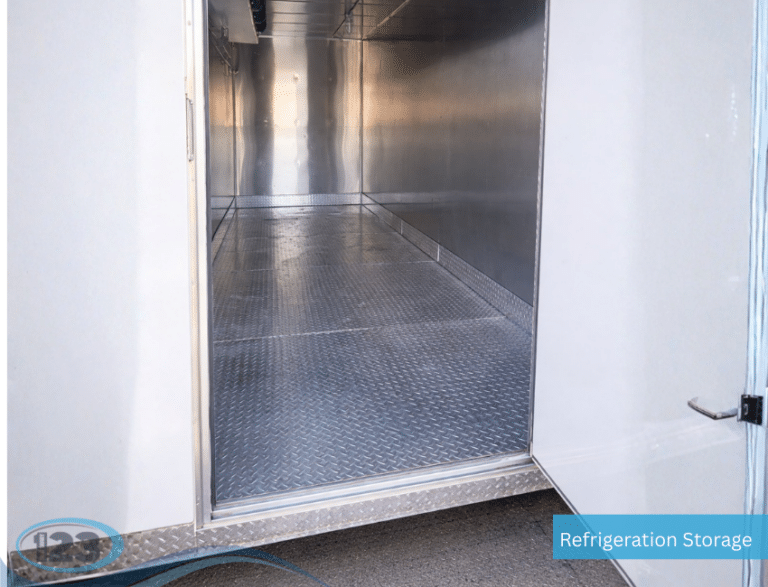
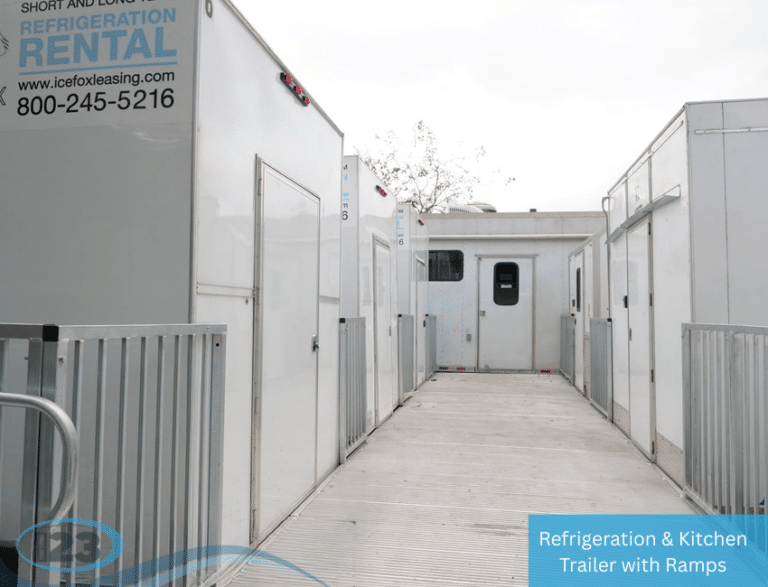
IcefoxEquipment supplies commercial refrigeration trailers, containers, walk-in refrigeration, and emergency freezer options, with rental pricing advertised from $1,295. Its website also describes nationwide delivery and support available 24 hours a day.
A popular trailer size is approximately 20 × 8.5 ft, while equipment is advertised in sizes extending up to 50 ft. That range allows the backup configuration to be sized around inventory rather than forcing a large commercial load into 1 undersized box.
For a restaurant, grocery store, hospital kitchen, food processor, hotel, school, or institutional operation, temporary refrigeration can create the protected storage location needed while electricians or refrigeration technicians restore the permanent system.
What Power Is Required for Emergency Refrigeration?
A common IcefoxEquipment refrigeration-trailer setup requires approximately 220V single-phase power at 40–60 amps. The uploaded setup material recommends 50–60 amps where repeated breaker trips indicate that the approved electrical setup needs review.
If the customer provides the documented connection, the source calls for a 50-ft, 6-AWG cable and a qualified commercial electrician. A household extension cord is not an appropriate substitute for a 40–60-amp commercial refrigeration load.
This is why we recommend checking power during the same 4-hour period in which refrigerated inventory is being protected. Having a trailer arrive without usable site power only moves the emergency from the walk-in cooler to the parking lot.
By the Numbers
| Power-outage decision | Figure |
|---|---|
| Unopened refrigerator window | About 4 hours |
| Full freezer holding window | About 48 hours |
| Half-full freezer holding window | About 24 hours |
| FDA refrigerator target | 40°F or below |
| IcefoxEquipment refrigerated target | 41°F or below |
| Frozen-storage target | 0°F or below |
| FDA discard threshold for listed perishables above 40°F | 2 hours or more |
| Common trailer power | 220V, 40–60 amps |
| Customer-supplied cable | 50 ft, 6 AWG |
| Emergency support | 24/7 |
These 10 numbers give a facility manager a workable framework: protect the cold air first, track time and temperature, and begin backup-refrigeration planning before the remaining safe-storage window disappears.
How Do You Save Perishables Step by Step?
Use this 8-step outage-response process.
- Record the outage time. Start the clock immediately because the closed refrigerator’s planning window is approximately 4 hours.
- Keep doors closed. Preserve the refrigerator’s 4-hour window and the freezer’s approximately 24–48-hour holding capability.
- Check reliable temperature data. Refrigerated product should be assessed against the applicable 40°F/41°F operating threshold.
- Start backup planning early. Contact IcefoxEquipment’s 24/7 support before the outage approaches the critical refrigerated-storage window.
- Prepare electrical service. A common rental trailer may need 220V single-phase, 40–60 amps.
- Pre-cool temporary storage. Do not move regulated food into a replacement unit until the required operating temperature has been verified.
- Transfer in controlled batches. Keep doors open for the shortest practical time and preserve airflow around the load.
- Document final disposition. Apply FDA guidance and your facility procedure to every product that exceeded its approved temperature limit.
How Should Food Be Loaded Into Emergency Cold Storage?
Keep food covered, labeled, separated, and arranged so cold air can circulate. IcefoxEquipment’s temporary-storage material recommends at least 3 organizational zones: ready-to-eat food, raw products, and nonfood or packaging materials.
Do not fill every inch simply because the temporary box has room. IcefoxEquipment compliance material gives an example in which the controller may show 38°F while a tightly packed area remains warmer because cartons block airflow.
FDA also advises against overpacking refrigeration because cold air needs to circulate. That same airflow principle matters during a 4-hour power-loss response when product is being moved rapidly into backup equipment.
What If the Backup Unit Loses Power Too?
Treat a backup-unit power failure as another temperature deviation, not just an electrical nuisance. IcefoxEquipment materials outline a 5-step corrective-action process: verify the reading, inspect the controller and operating conditions, move food to approved backup storage if needed, document the event, and determine product disposition.
Repeated breaker trips deserve immediate electrical review because a 40-amp circuit may not support a unit that requires closer to 60 amps. Do not repeatedly reset a breaker while assuming refrigeration protection has continued normally.
For emergency equipment help, call IcefoxEquipment at 800-245-5216 and provide the actual temperature, unit size, breaker status, electrical configuration, and the approximate time the temperature problem began.
What Common Power-Outage Mistakes Cause Food Loss?
Mistake 1: Opening the Cooler Every Few Minutes
The unopened refrigerator has an approximately 4-hour holding window. Repeated door openings release the cold air you are trying to preserve.
Mistake 2: Waiting Until Hour Four to Find Backup Storage
The 4-hour figure is a food-safety planning limit, not the ideal moment to begin calling rental providers. Start the contingency process much earlier if the restoration estimate is uncertain.
Mistake 3: Judging Food by Smell
FDA specifically says not to rely on appearance or odor after temperature loss. Food that has spent 2 hours or more above 40°F may require disposal even when it looks normal.
Mistake 4: Assuming Frozen Means Ruined
A full freezer may hold temperature for approximately 48 hours, and frozen food that still has ice crystals or remains at 40°F or below may still be safely refrozen or cooked under FDA guidance.
Mistake 5: Forgetting Backup Power Requirements
An emergency refrigeration trailer may require 220V, 40–60 amps. Finding the equipment quickly does not solve the outage if the temporary unit cannot be energized.
What Should Be on the Power-Outage Checklist?
- ☐ Record the exact outage start time.
- ☐ Keep the refrigerator closed during the approximately 4-hour holding period.
- ☐ Keep the freezer closed to preserve its approximately 24–48-hour window.
- ☐ Check refrigerated inventory against the applicable 40°F/41°F limit.
- ☐ Keep frozen inventory at 0°F or below when normal frozen storage resumes.
- ☐ Identify any listed perishable food that remained above 40°F for 2 hours or more.
- ☐ Contact IcefoxEquipment’s 24/7 support when temporary cold storage is needed.
- ☐ Prepare 220V, 40–60-amp electrical service for applicable refrigeration trailers.
- ☐ Verify the backup unit is cold before the 1st product is transferred.
- ☐ Document temperatures and corrective actions throughout the event.
Our strongest recommendation is to use the outage clock proactively. The difference between starting backup planning during hour 1 and beginning after hour 4 can determine whether you’re moving controlled product into a ready refrigeration unit or sorting through inventory whose temperature history is already uncertain.
Request a Quote
Request a quote today for industry-leading refrigeration, modular facilities, and mobile equipment solutions. Ice Fox Equipment provides rapid deployment, flexible rental and leasing options, and dependable support for construction, healthcare, food service, emergency response, and industrial operations. Contact our team now for a customized, no-obligation quote.

Frequently Asked Questions
USDA and FDA guidance says a closed refrigerator can generally maintain safe cooling for approximately 4 hours. A full freezer may hold temperature for roughly 48 hours, while a half-full freezer may last about 24 hours. IcefoxEquipment can provide temporary commercial refrigeration when longer backup storage is required.
Call IcefoxEquipment at 800-245-5216 as soon as restoration timing becomes uncertain rather than waiting for the refrigerator’s approximately 4-hour window to expire. IcefoxEquipment advertises emergency customer support 24/7 and temporary refrigeration rentals beginning at $1,295.
A common IcefoxEquipment refrigeration trailer requires approximately 220V single-phase power at 40–60 amps. Uploaded operating material also identifies a 50-ft, 6-AWG customer-supplied connection in applicable setups. Verify the actual unit nameplate and use a qualified commercial electrician.